Mark Hunter: The Sales Hunter’s 5 High-Profit Prospecting Strategies Every Outside Salesperson Needs
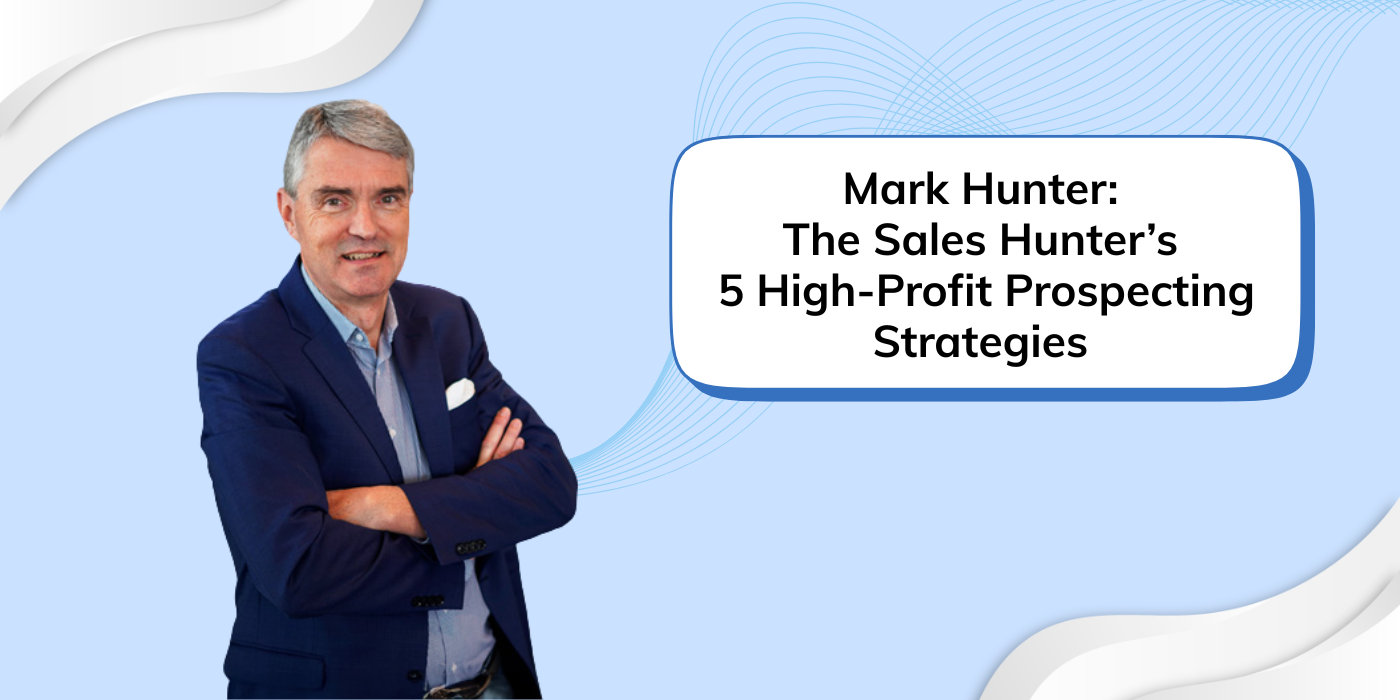
When Mark Hunter - known in the sales world as the Sales Hunter - sat down with Steve Benson on the Outside Sales Talk podcast, he delivered a no-excuses masterclass on the one activity most salespeople consistently under-invest in: prospecting.
As a 30-year sales veteran, author of High Profit Prospecting and High Profit Selling, and one of the top 50 most influential sales and marketing leaders in the world, Mark has a simple thesis: empty pipelines aren't a market problem or a product problem. They're a prospecting problem.
What makes Mark Hunter sales insights so valuable is their directness. No elaborate frameworks, no tech-stack dependency - just field-tested principles that work whether you're knocking on doors, dialing from a car, or firing off a cold email. For outside salespeople especially, his strategies translate immediately into more conversations, better-qualified leads, and more closed deals.
Here are the biggest Mark Hunter sales insights distilled from the interview. Listen to the full episode - High Profit Prospecting Strategies with Mark Hunter - on Apple Podcast, Spotify, Pandora, and YouTube.
Mark Hunter Insight #1 - How Confidence and Face-to-Face Prospecting Beat Every Other Channel
"Why shouldn't I interrupt them with the best strategy of all by walking in face to face? Confidence wins the game."
Mark's most fundamental prospecting belief is that showing up in person is the highest-leverage move available to outside salespeople - and that most reps overcomplicate the decision to do it. The research, the preparation, the perfect opening line - none of it matters as much as simply walking through the door.
- A phone call and a walk-in are both interruptions - one is just better: Mark's logic is disarmingly simple. If you're going to interrupt someone either way, do it face to face. "Sometimes I don't even have the phone number. And if I walk in, I'm interrupting them. So why shouldn't I interrupt them with the best strategy of all?" Steve confirms this from his own experience - he has never refused to come out and talk to someone who showed up in person.
- 30 seconds of preparation is enough: Keep a notebook organized by industry and jot down insights as you accumulate them. Before walking in, a quick 30-second review puts you in command of the language and context of that business - enough to be credible from the first sentence.
- Don't just use the front door: Employee entrances, loading docks, side doors - Mark has built relationships through all of them. For non-office calls especially, wandering in confidently through any entrance is a legitimate and effective approach. This is door-to-door sales at its most direct.
Why This Works: Confidence in prospecting comes from believing you can help the person you're about to meet. When that belief is genuine, walking through an unfamiliar door stops feeling like a risk and starts feeling like an obligation. As Mark puts it: "You feel it's your mission. You've got to get in touch with people."
Mark Hunter Insight #2 - How to Allocate Your Prospecting Time and Qualify Fast to Protect It
"You've got to be spending at least 20 to 25% of your time prospecting. And if I'm a new person, I'm probably doing 50 to 75%."
Time is a field salesperson's scarcest resource, and Mark is direct about where it should go. Most reps - especially veterans with established books of business - let prospecting slide because existing accounts create a constant pull on their calendar. The result is a pipeline that looks full but isn't moving.
- Existing accounts create a blind spot: Veteran salespeople who stop prospecting stop hearing what's happening in the market. They become dependent on a fixed customer base and lose the ability to identify new opportunities. "You become jaded by just hearing from your own accounts."
- Qualify immediately or waste everything: Mark draws a sharp distinction between leads, suspects, and prospects. Leads have to earn their way to prospect status - and salespeople who are afraid to ask tough qualifying questions early end up with what he calls a "sewer pipe" instead of a sales pipeline. Fast disqualification is a feature, not a failure.
- Return unqualified leads to marketing: Three words: return to sender. Leads that don't qualify shouldn't sit in a rep's pipeline consuming attention - send them back into a drip campaign and move on. "Salespeople never realize what is their most valuable asset when they're prospecting. It's their own time."
Why This Works: Protecting prospecting time requires both a calendar commitment and a ruthless qualification discipline. One without the other fails - you can block 90 minutes for prospecting and still fill it with bad leads. Both habits have to be built simultaneously.
PRO RESOURCE: Protecting prospecting time starts with managing your territory strategically. Read Jeb Blount's 8 Time Management Secrets: Impactful Habits of Ultra-High Sales Performers for a proven framework that complements Mark's prospecting discipline.
Mark Hunter Insight #3 - How to Use the "Fives" and Rinse-and-Repeat to Never Waste Dead Time
"Tomorrow begins today. You never end today without knowing exactly who you're going to be prospecting."
Two of Mark's most actionable habits address the dead time that field salespeople have in abundance - the gap between appointments, the drive across town, the five minutes in a parking lot. Most reps burn that time on ESPN or Starbucks. Mark has a system for it.
- The Fives: Every outside rep has micro-windows between appointments - five, ten, fifteen minutes. Mark keeps a running list of bonus calls to make and bonus stops to consider during those windows. Two doors left, two doors right. A quick phone call from the car. These small additions compound dramatically over a week. Route planning tools can help identify who's nearby when those windows open up.
- Rinse and repeat - but never the same message: Following up six or more times is often necessary to convert a prospect. The rinse-and-repeat principle from Mark's shampoo analogy has one critical caveat: every follow-up must bring new value. The same message repeated isn't persistence - it's noise. This is sales prospecting discipline at its most practical.
- Schedule prospecting like a client meeting: Mark is emphatic that prospecting time must be blocked on the calendar and treated as non-negotiable. Sales managers are specifically called out here - constantly redirecting reps toward account maintenance at the expense of prospecting time is one of the most common leadership failures in field sales.
Why This Works: The reps who hit their numbers consistently aren't necessarily making more calls than everyone else - they're making calls during the time everyone else is wasting. The Fives habit alone, built into a daily routine, can add dozens of meaningful touchpoints to a rep's prospecting cadence each month.
PRO RESOURCE: Building trust through prospecting is the foundation - referrals are what happens when you do it long enough. Read Joanne Black's strategies on how to use Referral Selling to Never Cold Call Again for the natural next step!
Mark Hunter Insight #4 - How to Write a Prospecting Email That Gets Read on a Phone in One Swipe
"If they can't read that email in one swipe, they're gonna delete it. Hi, my name is Mark Hunter, I'd like to introduce my - delete."
Cold email is one of the most abused channels in sales - and Mark's framework for getting it right is built around a single constraint: the email will almost certainly be read on a smartphone. Everything else flows from that.
- One swipe, four to six sentences, double-spaced paragraphs: The structure is non-negotiable. First paragraph: a question or insight relevant to their industry. Second paragraph: a one-line introduction. Third paragraph: a specific call to action - always asking for a phone call, never just an email reply.
- The subject line and first sentence are everything: Most prospects decide to open or delete based on the first 30-40 characters of the subject line and the first 150 characters of the body. If either of those is generic or self-focused, the email is gone. Lead with something specific to their industry or situation.
- Never attach files to an initial email: Attachments trigger spam filters and - more importantly - give the prospect enough information to make a decision without talking to you. "I never want to provide you with enough information for you to make a decision without talking to me. That's my goal." The email exists to earn a conversation, nothing more.
Why This Works: The one-swipe rule forces a discipline that most salespeople resist - brevity. The instinct to explain, educate, and justify is exactly what kills cold emails. The only job of a prospecting email is to generate enough curiosity for a reply or a call.
PRO RESOURCE: Cold email is just one piece of a modern prospecting system. Read Bill Rice's guide on how to Master AI to Automate and Modernize Your Sales Performance for a complementary look at how to systematize and scale your outreach.
Mark Hunter Insight #5 - How to Use Micro Commitments to Build Trust and Advance Every Prospect Conversation
"Low trust equals low price. If you want to maximize price, you've got to create a higher level of trust and you do that through the prospecting process."
One of the sharpest ideas in the conversation is Mark's concept of micro commitments - small, specific asks that create forward momentum in a prospect relationship without requiring a major decision. They work because of what they reveal: a prospect who shares proprietary information or agrees to a follow-up call has already invested something in the relationship.
- A scheduled call is a micro commitment: After any initial touchpoint - phone, walk-in, email reply - Mark's immediate goal is to lock in a specific next meeting. "Hey, let's schedule a time next Tuesday at 10 a.m." That single agreement signals interest and creates accountability on both sides.
- Repeating back what they said is a micro commitment trigger: When a prospect shares something specific in conversation, echo it back in your next touchpoint. "In the first line of the email, exactly what you shared with me." The prospect's reaction - "this salesperson actually listened" - creates the foundation for the trust that eventually justifies full price.
- Proprietary information is the qualifying signal: Mark's definition of a qualified prospect is someone who has shared something not publicly known. "You're not going to share that with me unless you have a level of trust and confidence with me." If you can't get a prospect to share anything proprietary, you haven't earned the relationship yet.
Why This Works: Micro commitments move prospects through the funnel incrementally, without the pressure that triggers resistance. Each small act of reciprocity - a scheduled call, a shared detail, an answered question - increases the perceived cost of walking away. By the time you're discussing price, the relationship has already been established.
Steve Benson Bonus - Why Hunters Should Hunt, and How Protecting That Role Changes Everything
"I love if you can pass off a relationship from a salesperson to more of an account manager. If a person's a hunter, you want them to hunt and close the deal and then have the ability to pass it off. Because existing customers can suck you dry."
Steve Benson's most pointed contribution to the prospecting conversation wasn't about technique - it was about structure. The reason most salespeople can't find time to prospect isn't laziness or poor calendar management. It's that they're being asked to do two fundamentally incompatible jobs at once.
- Hunters and farmers require different wiring: Steve's observation is that great hunters and great account managers are rarely the same person. Forcing a rep who thrives on new business to also manage and upsell existing accounts doesn't produce a versatile salesperson - it produces an overburdened one who does neither job well.
- Account management quietly kills prospecting: When existing customers can pull a rep's attention at any moment, the 90-minute prospecting block is always the first thing to go. Not because the rep doesn't value prospecting - because the customer in hand always feels more urgent than the prospect not yet in the pipeline.
- Passing off accounts is a force multiplier: A hunter freed from account management can cover dramatically more prospecting ground. The accounts don't suffer - they often get better service from a rep whose entire job is retention. And the pipeline gets the sustained attention it needs. This is one of the most underleveraged levers in field sales management.
Why This Works: Mark's entire prospecting framework depends on time - time to walk in doors, time to make the Fives calls, time to follow up six times with new value each time. That time doesn't materialize through discipline alone. Time has to be structurally protected, and the clearest way to protect it is to stop asking hunters to be something they're not.
Final Takeaways
Mark Hunter sales insights come down to one core belief: you are out there because you can help people achieve things they couldn't achieve without you. That belief - not a script, not a framework, not a technology - is what makes a rep prospect with confidence, qualify without fear, and follow up without apology.
The mechanics support the belief. The Fives fill dead time. The one-swipe rule gets emails read. Micro commitments build the trust that justifies full price. And the outcomes list keeps a rep moving through rejection with purpose.
The pipeline is a direct reflection of prospecting behavior. Nothing comes out the bottom unless something goes in the top - and the reps who understand that show up every day ready to put something in.
Who is Steve Benson?
Steve Benson is the founder and CEO of Badger Maps, the leading route planning and territory management app for field sales reps. He hosts the Outside Sales Talk podcast, where he interviews top sales experts to bring actionable strategies directly to salespeople in the field. Steve was also named a LinkedIn Top Sales Voice.
Who is Mark Hunter?
Mark Hunter, known as the Sales Hunter, is recognized as one of the top 50 most influential sales and marketing leaders in the world. With over 30 years of sales experience, he has conducted thousands of training programs and keynote speeches globally and has helped companies across industries identify better prospects, close more deals, and build profitable long-term customer relationships. He is the author of High Profit Prospecting and High Profit Selling: Win the Sale Without Compromising on Price.
What is High Profit Prospecting about?
High Profit Prospecting is Mark's field guide for finding and closing better leads - without discounting. The book covers everything from cold calling and email outreach to qualification, follow-up, and pipeline management, with a consistent emphasis on protecting price by building trust through the prospecting process. It is available at thesaleshunter.com and wherever books are sold.
Where can I find more related sales strategies?
For more on Mark Hunter's work, visit thesaleshunter.com where his phone number and email are publicly listed. And of course, follow him on LinkedIn.
For more on high-performance prospecting and field sales strategies, read our guide on sales prospecting: the ultimate guide, explore how to build a sales strategy, and discover how to become a top sales performer.
The leading app for field teams
Badger Maps is a routing & mapping app that automates data collection and uplevels field team performance. From planning your day to managing your territories, Badger optimizes every aspect of the field sales process.
90-day money back guarantee
No set up fees.


Related
Looking for our logo?
Grab a Zip packed with our logo in PNG and EPS formats.