Victor Antonio’s Sales Framework: How to Master Your Sales Presentations and Close More Deals
By Steven Dew
Posted in Closing, Interviews, Presentations, Sales Tips
By Steven Dew
Posted in Closing, Interviews, Presentations, Sales Tips
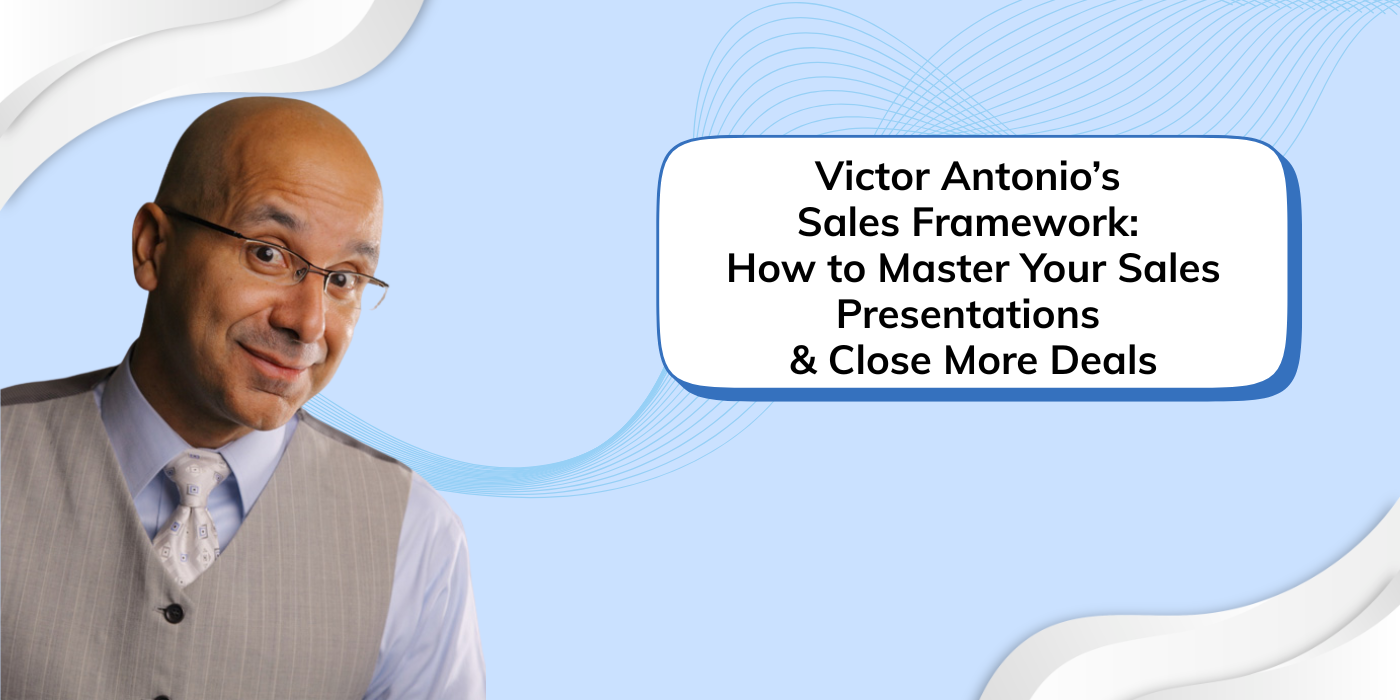
When Victor Antonio joined Steve Benson on the Outside Sales Talk podcast, he made one thing clear from the start: most salespeople have a sales process, but almost none of them have a presentation process. And that gap - between knowing how to sell and knowing how to present - is where deals are quietly won and lost.
As the author of 13 books on sales, founder of the Sales Mastery Academy, and a former president of global sales and marketing for a $420 million company, Victor has spent his career studying exactly what separates presentations that advance deals from ones that generate polite nodding followed by radio silence.
His core argument is that the visible part of any sales conversation - price, features, ROI - is just 10% of what actually drives a buying decision. The other 90% lives below the waterline, and most salespeople never go near it.
Here are the biggest Victor Antonio sales insights from the interview. Listen to the full episode - How to Master Your Sales Presentations with Victor Antonio - on Apple Podcast, Spotify, Pandora, and YouTube.
Victor Antonio Insight #1 - How to Uncover the Latent Needs That Actually Drive Buying Decisions
"It's never about pricing. If I understand what's holding you back from making a buying decision - really understand it - then I can sell to that more effectively when I present to you."
The iceberg analogy is well-worn, but Victor's application of it is more specific and actionable than most. The 10% above the waterline - price, features, ROI - is what salespeople prepare for. The 90% below is what kills deals after the rep leaves the room.
- Above the waterline is table stakes: Prospects expect you to address pricing and make the value case. That's not differentiation - that's the minimum. The buyer's real internal monologue after your presentation is about switching costs, retraining time, data migration, integration with existing systems, and who internally will have to own the implementation. If those questions aren't answered, the deal stalls regardless of how strong your product demo was.
- Run a latent needs session with your team: Victor's practical recommendation is to put your sales team in a room for two hours and ask one question: what's really holding customers back from buying - beyond price and features? A tenured team of 10 to 20 reps will surface 30 to 40 friction points. Find the five to seven that come up most often. Those are your presentation's hidden agenda.
- Call the ones who didn't buy: Prospects who passed without explanation are one of the most underused sources of intelligence in sales. A simple call - "I'm not trying to sell you, I just want to understand what held you back" - often produces candid answers that have nothing to do with your product and everything to do with the 90% below the waterline. These insights directly sharpen how you handle sales objections in future presentations.
Why This Works: Deals don't die because prospects don't like the product. Deals die in the private conversations that happen after the rep walks out. Addressing latent needs inside the presentation eliminates the objections that never get raised out loud.
Victor Antonio Insight #2 - How to Block Objections Before They Become Positions
"When you raise the objection, you control the objection. If the customer brings it up, now you're defending yourself."
This is one of the most tactically important ideas in the conversation. The conventional sales training approach - prepare to overcome objections when they arise - puts the rep in a reactive position by design. Victor's inversion is simple: raise the objection yourself, before anyone else does, and you control the narrative entirely.
- A prospect who states an objection has taken a position: Once someone in the room says "you can't transfer our data," they've publicly committed to a concern. Now every person who respects that individual is recalibrating. The room that was nodding along moments before is now skeptical - and you're defending yourself instead of selling. The same objection, raised by you proactively, lands completely differently.
- The five to seven objection block: Know your most common latent objections going in. Find the natural moment in your presentation to raise each one - typically as you move from problem to solution. The formula is consistent: name the concern, show proof it isn't an issue, tie it down. "Many people worry about data migration. Here's exactly how we handle it, and here's what our last three customers experienced." Resistance drops visibly when you do this well.
- Proactive blocking is a form of consultative selling: It signals that you understand the buyer's world deeply enough to anticipate their concerns - which is itself a differentiator. The rep who names the fear before the prospect does is the rep who gets trusted.
Why This Works: Objection blocking shifts the psychological dynamic of the presentation. Instead of defending your product against the room's concerns, you're the one who identified those concerns and resolved them. That's a fundamentally different relationship with the audience.
PRO RESOURCE: Objection blocking works best when you already know your buyer's decision-making process. Read Brent Adamson and Karl Schmidt's insights on how to win more B2B deals by building customer decision confidence for a complementary framework on what's happening inside the buyer's mind before they ever raise a concern.
Victor Antonio Insight #3 - How to Structure a Presentation Using the Hero Story and the 16-Square Method
"The biggest mistake salespeople make is spending the first five to ten minutes talking about themselves. That's the most valuable time you have in front of a customer."
Victor's structural framework for presentations solves two problems at once: it forces reps to lead with the prospect's pain instead of their own company bio, and it gives them a physical planning tool - a folded sheet of paper - to map the entire presentation before opening PowerPoint.
- The 16-square method: Take an 8.5x11 sheet of paper and fold it four times. You get 16 squares, each representing roughly two to three minutes of presentation time. Plan the full arc on paper before touching slides - what's the opening impact, where do objection blocks land, where does the demo go, what's the close. This prevents the common trap of building slides from the front and losing the thread of the argument entirely.
- The hero story structure: Open with three specific problems you know the prospect is experiencing - problems your product solves. Spend the first five to ten minutes demonstrating that you understand their business. Then introduce your solution as the response to those three problems, working through each one while layering in objection blocks as you go. Probe for confirmation after each section. By the time you reach the close, it feels like a natural conclusion, not a pivot.
- Never open with who you are: The company background, the mission statement, the logo slide - all of it can wait. "The fact that you're in the room already tells me you're somewhat important. Now give me a reason to listen." The first minutes should be spent entirely on the prospect's market situation, challenges, and what's at stake if nothing changes. This is the foundation of a great sales pitch.
Why This Works: The hero story works because it mirrors the way buyers actually think - they want to know you understand their problem before they care about your solution. Leading with their pain earns the right to present your product. Leading with your company bio burns the most valuable minutes of the meeting.
Victor Antonio Insight #4 - How to Use Social Proof to Reduce Anxiety and Close Competitive Deals
"Sales is always about raising certainty and reducing anxiety. Raising certainty and reducing anxiety."
In a world where product quality is largely at parity - what Victor calls "the equality of quality" - the differentiator isn't the product, it's how confidently and specifically you address the implementation anxiety that every buyer carries. Social proof, used well, does more work here than any feature comparison.
- The brain wants before and after: Victor's most memorable framing here is neurological. Prospects aren't just evaluating your product - their brain is running a contrast comparison between where they are now and where they'll be after making the switch. Too many presentations show the "after" without acknowledging the "during" - the transition period that actually frightens buyers. Show them both.
- Live references beat recorded testimonials: Video testimonials are expected. What isn't expected is calling a happy customer live during the presentation. Victor kept his best customers on standby - available by phone between specific hours on presentation days - specifically to be brought in when implementation anxiety peaked. The prospect asking questions directly to a peer who went through the same process is worth more than any case study. Steve reinforces this with his own version: introduce the prospect to a satisfied customer over email, then step away entirely and let them talk candidly without the rep present.
- In competitive situations, differentiate below the waterline: When products are nearly identical, the rep who wins is the one who addresses the changeover anxiety most specifically. Walk through the implementation blueprint step by step. Name the stages, the timeline, the support touchpoints. "You can buy the product anywhere. I'm here to show you how we get you there."
Why This Works: Certainty closes deals. Anxiety stalls them. The rep who makes the prospect feel the transition is manageable - with specifics, not reassurances - removes the last major obstacle between a great presentation and a signed contract.
PRO RESOURCE: Social proof is most powerful when it's built into a repeatable sales process. Read Paul Smith's insights on how to Elevate Your Sales Process Through Storytelling for a complementary framework on how to structure customer stories that land.
Victor Antonio Insight #5 - How to Close on a Glide Path Instead of a Switch
"You're closing throughout. The close begins once I present my solution. 63-64% of salespeople never ask for the order. That's shocking."
The closing problem isn't a technique problem - it's a mindset problem. Reps who think of the close as a distinct phase at the end of a presentation set themselves up for an awkward pivot that prospects can feel coming. Victor's alternative is to treat the entire back half of the presentation as a continuous series of small confirmations that build naturally toward the final ask.
- Probe after every solution block: After addressing each of the three core problems in the hero story, stop and check in. "Based on what I've shown you for problem A - does that make sense? Any questions?" These micro-confirmations serve two purposes: they surface resistance early, when it's easier to address, and they establish a rhythm of agreement that makes the final ask feel like the logical next step rather than a sales move.
- Know your desired outcome before you walk in: The closing ask should be specific to the next stage in your sales process - a field trial, a demo, a second meeting. "Is there any reason we couldn't start a field trial next week?" is a better close than a generic "are you ready to move forward?" If you don't know what you're asking for, the presentation doesn't have a destination.
- You've earned the right to ask: Victor is emphatic on this. Getting all the decision makers in a room took months of emails, calls, and preparation. The rep who spent that time and effort and then doesn't ask for the next step is leaving the most important part of the job undone. "Most salespeople don't feel they've earned that right. They think like beggars." The close isn't pressure - it's the natural completion of a presentation that delivered real value.
Why This Works: A glide path close works because it removes the psychological discontinuity between presenting and asking. When a rep has been seeking confirmation throughout, the final ask doesn't feel like a shift in intent - it's been clear all along where things were heading. And if resistance surfaces at the close, it reveals exactly what the presentation didn't resolve, which is itself valuable information.
PRO RESOURCE: Want to be more prepared when going off script? Read Lee Salz's insights on Sales Differentiation: 6 Fresh Ways to Turn First Meetings into "When Can We Talk Again?" Moments for a complementary look at how to make every presentation feel like it was built specifically for that room.
Steve Benson Bonus - How to Read the Room and Go Off Script When Your Audience Already Knows the Basics
"If they just wanted to do basic research on us or the product, they've probably been to the website. Don't stick to the script - fly through those slides and get into the deeper stuff."
Steve's contribution to the presentation conversation addresses one of the most common failure modes in structured sales presentations: delivering a scripted deck to an audience that's already past it. The rep who misreads the room's knowledge level and proceeds as planned loses the audience's respect and the meeting's momentum simultaneously.
- Audit the room before you start: Victor's technique is to ask the room directly - "How many of you have already looked into our company? What stood out?" This surfaces both how much they know and what framing has already taken hold. A prospect who says "I've heard you're strong on X but weak on Y" has just handed you your opening objection block. More importantly, you now know where the presentation can accelerate and where it needs to linger.
- Depth of knowledge changes everything about pacing: Steve's point is practical - a room of informed buyers doesn't need the foundational slides. Spending five minutes on a product overview to people who've already watched your demo videos is a credibility drain. Recognizing the signal and adapting in real time is what separates a top sales performer from a rep who runs the same deck regardless of context.
- Absorb what is useful, discard what is not, add what is uniquely yours: Victor closes with a Bruce Lee quote that applies directly to the off-script challenge. No framework - including the hero story - should be applied rigidly. The structure exists to serve the conversation, not replace it. A rep who has internalized the principles can flex when the room calls for it.
Why This Works: The most compelling presentations feel like conversations, not deliveries. Reps who can read the room and adapt their depth, pace, and focus in real time demonstrate the kind of market and customer knowledge that makes prospects want to keep talking - and that's the point.
Final Takeaways
Victor Antonio sales insights come down to a single reframe: the presentation doesn't start when you open your deck. It starts when you understand what's keeping your prospect up at night - not the price, not the feature gap, but the quiet anxiety about what it will actually take to change. The rep who walks in having already mapped that 90% below the waterline, who raises the hard objections before anyone else does, who leads with pain before product, and who closes on a glide path instead of a switch - that rep is operating in a different category.
Only 18% of executives find a salesperson's presentation genuinely valuable. The gap between that number and 100% is exactly what this framework addresses.
Who is Steve Benson?
Steve Benson is the founder and CEO of Badger Maps, the leading route planning and territory management app for field sales reps. He hosts the Outside Sales Talk podcast, where he interviews top sales experts to bring actionable strategies directly to salespeople in the field. Steve was also named a LinkedIn Top Sales Voice.
Who is Victor Antonio?
Victor Antonio is a sales strategist, keynote speaker, and the author of 13 books on sales and motivation. He is the founder of the Sales Mastery Academy, an online learning platform with over 300 videos across more than 34 courses on sales. Victor spent 20 years as a top sales executive, rising to president of global sales and marketing for a $420 million company. He has shared the stage with leaders including the CEO of Intel and the CEO of FedEx Kinkos, and consults with companies around the world on sales presentation strategy and performance.
What is the Sales Mastery Academy?
The Sales Mastery Academy is Victor's online sales training platform, offering over 300 videos across courses on presentations, objection blocking, closing, prospecting, and more. It is available at victorantonio.com.
Where can I find more related sales strategies?
For more on Victor Antonio's work, follow his YouTube channel or connect with him on LinkedIn.
For more on structuring winning presentations and closing more deals, read our guide on how to be persuasive in sales, explore the 22 best sales techniques, and discover how to overcome the 7 most common sales objections.
The leading app for field teams
Badger Maps is a routing & mapping app that automates data collection and uplevels field team performance. From planning your day to managing your territories, Badger optimizes every aspect of the field sales process.
90-day money back guarantee
No set up fees.


Related
Looking for our logo?
Grab a Zip packed with our logo in PNG and EPS formats.