Chris J Reed on Sales: Expert LinkedIn Tactics to Grow Your Pipeline & Build Your Brand
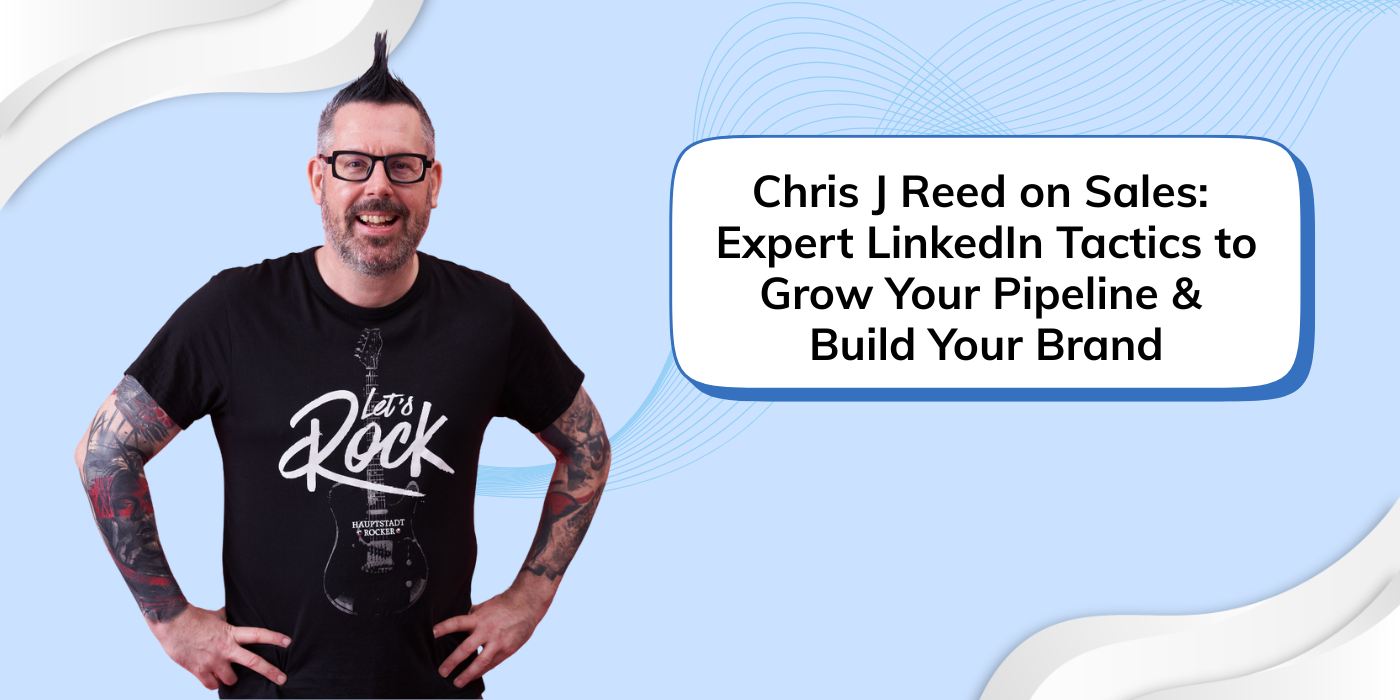
When Chris J "Mohawk" Reed joined Steve Benson on the Outside Sales Talk podcast, he brought a perspective most LinkedIn advice misses entirely: the platform isn't just a networking tool - it's a data-driven prospecting engine that most salespeople are barely using.
As the most recommended LinkedIn marketing entrepreneur on the platform, a four-time international bestselling author, and founder of Black Marketing, Chris built his entire business through LinkedIn after moving to Singapore without knowing a single person. His tactics are specific, tool-level, and immediately actionable.
Here are the biggest Chris J Reed sales insights from the interview, distilled into actionable tactics.
Listen to the full episode - Expert LinkedIn Tactics to Grow Your Sales and Brand with Chris J Mohawk Reed - on Apple Podcast, Spotify, Pandora, and YouTube.
Chris J Reed Insight #1 - How to Build a LinkedIn Profile That Works as a Sales Tool, Not a Resume
"The number one thing people do on their profiles is say what they do at the company - not what the company does for customers. Your profile is for communicating to your prospects so that you sell more."
LinkedIn is the first result when someone Googles your name - and it's the first thing any prospect checks before agreeing to a meeting. A weak profile doesn't just fail to help; it actively costs deals before a conversation ever starts.
- Your headline is your most valuable SEO real estate: LinkedIn operates like Google but with no paid search - it's entirely organic. The algorithm surfaces profiles based on the words in your headline, so use them deliberately. If you sell medical devices, say so explicitly. Chris uses the word "LinkedIn" five times in his own headline because the algorithm rewards keyword density. At 220 characters, the headline has enough room to describe what you do, who you do it for, and the value you deliver. When your profile appears in someone's "who viewed this profile also viewed" section, that headline is the only thing they see - make it sell.
- Your banner image is free advertising: The banner is the largest visual element on your profile and the first thing visitors see. It should communicate your value proposition and be sized for mobile - where most people view LinkedIn. A photo of the Golden Gate Bridge is wasted space. Chris rotates client banners monthly, treating them as active marketing assets rather than static decoration. For field sales reps, this is a quick win: have your marketing team create two or three branded options and make them available company-wide.
- Profile photo and company page matter more than people think: A cropped holiday photo signals the same carelessness as a missing profile photo. A professional headshot is the minimum. On the company side, a gray box where your employer's logo should be - because someone typed in a made-up company name - tells visitors the business isn't real. It takes one minute to create a company page with a logo. There's no excuse not to.
Why This Works: Your LinkedIn profile is your digital first impression - and unlike a cold call, it's working around the clock. Prospects are checking it before they agree to meetings, before they respond to messages, and sometimes before they even know you exist. A profile optimized for what you sell is one of the highest-ROI investments a field rep can make.
Chris J Reed Insight #2 - How to Use Sales Navigator to Find Prospects Who Actually Want to Be Contacted
"Sales Navigator tells you who's posting on LinkedIn, who's premium, and who has an open profile - people who have literally said, I want to be contacted."
Of LinkedIn's roughly 700 million registered users, only about 250-300 million are active monthly. Of those, the ones worth targeting are a smaller, identifiable subset - and Sales Navigator is the tool that finds them.
- Open profiles are the highest-value prospecting targets: When someone buys LinkedIn Premium, their profile is set to open by default - meaning anyone can message them for free, regardless of connection level. People who have gone into their settings and switched this off have explicitly signaled they don't want unsolicited contact. Chris targets open profiles exclusively for outreach, skipping InMails and connection requests entirely for this group. The logic is simple: these people opted in.
- Sales Navigator's filters go far beyond basic search: Title, industry, company size, geography, posting activity, shared connections, whether they've been approached before - all of it is filterable. Chris runs saved searches for Forbes columnists, book authors, university alumni, and other shared-identity groups specifically because personalization based on something real converts dramatically better than generic outreach. You can also search by hashtag - if you sell medical devices, search #medicaldevices to find everyone actively posting about it.
- Save 100 leads to create a curated prospect feed: Rather than scrolling an overwhelming general feed, Chris saves his top 100 active prospects in Sales Navigator and monitors only their activity. When a saved prospect posts content, he likes or comments on it - creating visibility without a direct pitch. "They see that Chris is very attentive. Next time they need LinkedIn help, they know who to call." The prospect never knows they've been saved. This is sales prospecting with a long game built in.
Why This Works: Most prospecting tools tell you who exists. Sales Navigator tells you who's active, who wants to be contacted, and who's already engaging with relevant content. The difference between a cold list and a warm, filtered, intent-signaled list is the difference between a low response rate and a meaningful one. At roughly $1,000 per year, one closed deal pays for it entirely - and the ROI case to a sales manager writes itself.
PRO RESOURCE: LinkedIn prospecting is most effective when paired with a strong outreach process. Read Mark Hunter's high-profit prospecting strategies for a complementary framework on cold outreach, follow-up cadence, and qualifying fast.
Chris J Reed Insight #3 - How to Use Smart Links to Follow the Data and Only Chase Interested Prospects
"If I send 100 messages with Smart Links and 25 people click, I don't go after the 75 who didn't look. I go after the 25 who did. Why would you bother someone who hasn't bothered looking at your services?"
Smart Links - available exclusively on Sales Navigator - solve one of the oldest problems in outreach: not knowing whether anyone actually looked at what you sent. They work by attaching LinkedIn's user data to a trackable document link, so you can see exactly who opened it, how many times, and for how long.
- Time-on-document is the qualifying signal: Someone who spends 16 minutes with your content across three sessions is a different prospect than someone who clicked once for 10 seconds. Chris uses 30-50 seconds as his threshold - below that, he doesn't follow up. Above it, he reaches out with specific reference to what they viewed. "You looked at my document three times for 16 minutes - you're obviously very keen. Can we have a conversation?"
- Smart Links shift outreach from volume to precision: Instead of following up with everyone who received a message - which burns time and goodwill - Smart Links let you direct your energy exclusively toward demonstrated interest. The 25% who engaged are worth pursuing. The 75% who didn't aren't - at least not yet.
- Keep the initial message short, sharp, and linked: LinkedIn's own data shows that messages over 200 words are ignored. The formula: a personalized opener, two to three sentences on what you can do for them, and a Smart Link to supporting material. The message earns the click. The Smart Link earns the follow-up. The follow-up earns the meeting. Each step is gated by actual behavior, not assumption.
Why This Works: Data-driven outreach isn't just more efficient - it's more respectful. Prospects who receive a follow-up that references something they actually engaged with feel seen rather than spammed. And reps who stop chasing cold signals have more energy for the warm ones.
Chris J Reed Insight #4 - How Content Posting Puts You in the Top 5% of LinkedIn Users Without Trying
"95% of people in America do nothing on LinkedIn. They don't post. If you are a salesperson who wants to stand out - share. Automatically, you become a thought leader. You go straight to the top 5%."
This is the most underleveraged insight in the entire conversation - and the one with the lowest barrier to entry. Posting content on LinkedIn isn't just a branding exercise; it's an algorithmic signal that increases your visibility in search, in suggested profiles, and in the feeds of your existing connections.
- LinkedIn rewards active users with algorithmic promotion: Being premium increases your search ranking. Having connections increases it further. Posting content increases it more. Every piece of content you share increases the likelihood that prospects who fit your target profile will encounter your name before you've ever reached out to them. This is inbound social selling working passively on your behalf.
- Content gives you permission to market without selling: Steve's framing of this is worth repeating: the Outside Sales Talk podcast doesn't sell Badger Maps - it creates value for outside salespeople, who happen to be Badger Maps' customers. The result is that every listener has given implicit permission to be marketed to. Field sales reps who post about their industry - tips for dentists, insights for medical device buyers, observations from the field - are doing the same thing at an individual level.
- What's your mohawk? Chris's question applies directly to content strategy. You don't need a physical differentiator - you need a point of view. A contrarian take on a common assumption in your industry, a pattern you've noticed across a hundred customer conversations, a behind-the-scenes story from the field. Original, authentic content at 200 words, posted consistently, is all it takes to stand out in a space where almost no one is doing it.
Why This Works: Content compounds. A rep who posts once a week for six months has 25-plus pieces of content working for them in search, in feeds, and as context for every outreach they send. It's the kind of sales tool that works while you're on the road.
PRO RESOURCE: Read Joanne Black's strategies on how to use referral selling to never cold call again for a complementary look at how relationships - built online and off - replace cold outreach entirely over time.
Steve Benson Bonus - How to Turn Your Company's LinkedIn Presence Into a Consistent, Scalable Sales Asset
"I don't just tell all the employees, 'hey, make your LinkedIn profile better.' Someone from our marketing team came up with a document - do this, upload this, describe this field this way. In 45 minutes, you can make everyone on your sales team's profile good."
Steve's contribution is operational: the insight that LinkedIn profile optimization shouldn't be left to individual reps, and that a one-time coordinated effort produces better, faster, more consistent results than asking everyone to figure it out on their own.
- Treat profile optimization as a team project, not individual homework: A Zoom call, a one-page guide, two or three pre-designed banner options, a company description paragraph that mirrors the approved company page - these are 45-minute investments that pay dividends for years. Every rep who walks away with an optimized profile is a new outbound channel for the company's brand.
- Your profiles are a de facto brand touchpoint: When a prospect views a rep's profile and then clicks through to a colleague's, they're forming an impression of the company based on both. Consistency in banner design, company description, and value-forward headlines makes the whole team look like a professional organization rather than a collection of individuals using LinkedIn as a job board.
- Never automate your LinkedIn outreach: Chris is emphatic on this - automated platforms violate LinkedIn's terms of service, get detected by the algorithm, and result in "LinkedIn jail," where you're required to enter email addresses to connect. More practically, they produce messages that are obviously automated. The tell: someone addressing Chris as "Chris J. Mohawk Reed" instead of "Chris," or assuming he's the CMO of Forbes because the bot read his contributor credit wrong. Personalization is the entire point. Automation destroys it.
Why This Works: A sales team with consistent, optimized profiles, a shared content strategy, and a no-automation discipline is doing LinkedIn correctly at scale. The reps benefit individually, and the company benefits from the cumulative brand impression.
Final Takeaways
Chris J Reed sales insights reframe LinkedIn from a passive professional presence into an active, data-driven pipeline tool. The profile is your first impression. The content is your long-game brand. Sales Navigator is the engine that finds the right people. Smart Links tell you who's actually interested. And automation is the fastest way to destroy all of it.
Only 5% of salespeople are posting. Almost no one is using the data the way Chris describes. The opportunity cost of ignoring LinkedIn isn't abstract - it's the meetings that never happened because your profile was incomplete, your headline was a job title, and your outreach was generic.
For more on social selling, prospecting, and building a digital presence that drives pipeline, read our guide on social selling: definition, best practices, and strategies, explore sales prospecting: the ultimate guide, and discover the ultimate sales tech stack for field salespeople.
The leading app for field teams
Badger Maps is a routing & mapping app that automates data collection and uplevels field team performance. From planning your day to managing your territories, Badger optimizes every aspect of the field sales process.
90-day money back guarantee
No set up fees.


Related
Looking for our logo?
Grab a Zip packed with our logo in PNG and EPS formats.