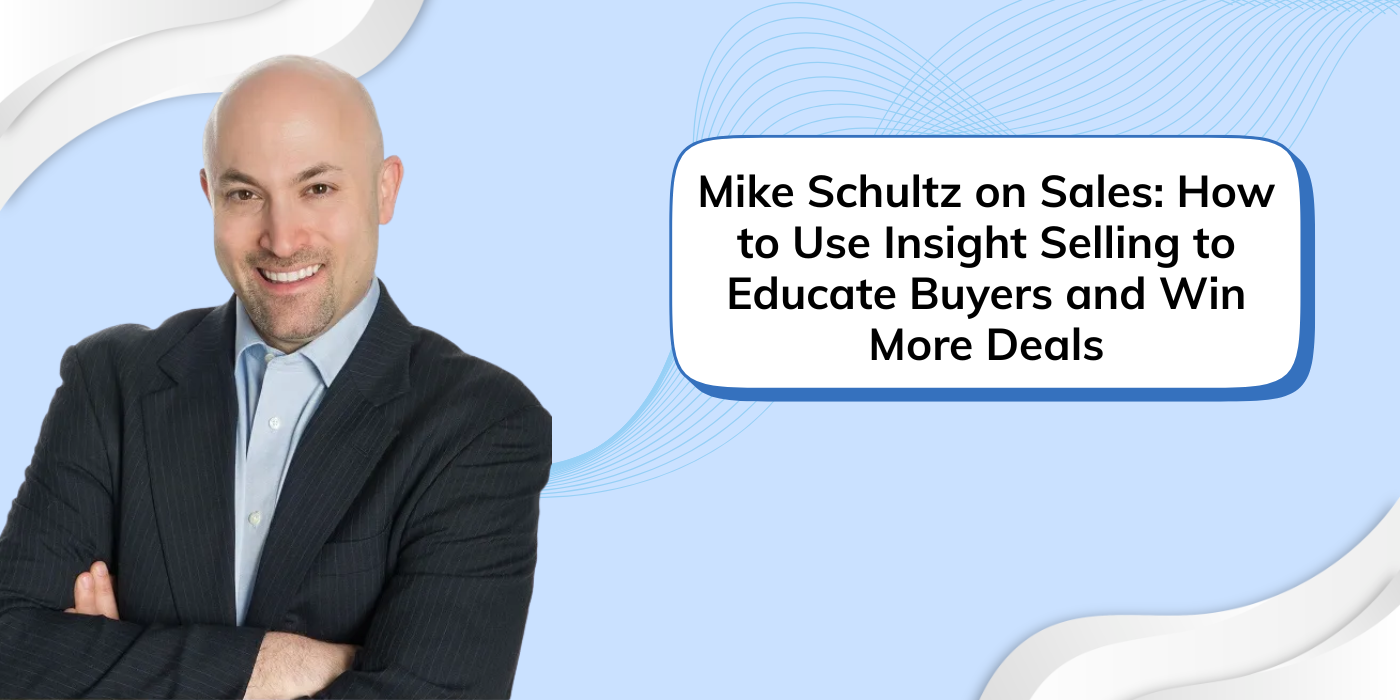
Mike Schultz on Sales: How to Use Insight Selling to Educate Buyers and Win More Deals
Consultative selling used to be the gold standard... now it's just the entry fee.
Mike Schultz - president of Rain Group, director of the Rain Group Center for Sales Research, and Wall Street Journal bestselling co-author of Insight Selling and Rainmaker Conversations - joined host Steve Benson on Outside Sales Talk to make a case that changes how you think about every sales conversation. Based on a study of 731 real B2B purchases comparing what winners did differently from second-place finishers, Mike's research reveals that understanding needs and crafting solutions is no longer enough to win - it's only enough to stay in the game.
What separates today's sales winners is their ability to educate buyers with new ideas, collaborate on solutions, and build the kind of trust that makes prospects say "why would I go with anyone else?" Here are the biggest Mike Schultz sales insights distilled from the interview.
Listen to the full Outside Sales Talk episode How to Become a Sales Winner with Insight Selling with Mike Schultz or find it on Apple Podcasts, Spotify, Pandora, and YouTube.
Mike Schultz Insight #1 - How to Move Beyond Consultative Selling and Actually Win
"The sellers that educated buyers with new ideas and perspectives, collaborated with the buyer, and persuaded the buyer they would achieve results - those are what differentiated the winners from the second place finishers."
Mike's research is unambiguous: the consultative selling playbook that dominated sales for 30+ years is now table stakes. Every competent seller understands needs and proposes solutions. What separates winners today is a willingness to go further - to shape how buyers think, not just respond to what they ask for.
- Consultative selling is the ante, not the advantage: If you're doing thorough needs discovery and crafting tailored solutions, you're doing what everyone else is doing. You haven't differentiated yourself - you've simply qualified to compete.
- Challenge the RFP, don't just answer it: When a buyer sends an RFP, most sellers fill it out and send it back. But RFPs are rarely well-written. Mike's advice: ask yourself whether the way the buyer has framed their problem is actually going to get them the best outcome. If not, get in there and change their thinking before you respond.
- Educate buyers on what they don't know to ask: The two-column exercise - "what do buyers typically think" versus "what they should think" - is Mike's framework for developing insight questions. Write out where buyer assumptions tend to be wrong, then reverse-engineer questions that surface those gaps naturally.
Why This Works: Buyers aren't always wrong, but they're often working with incomplete information, outdated assumptions, or poorly framed problems. The seller who helps prospects think more clearly about their situation doesn't just win the deal - they become the obvious choice. As Mike puts it, when buyers get that kind of treatment, "they literally can't wait to tell us in postmortems about how it went."
PRO RESOURCE: For more on educating buyers and differentiating your approach from the very first meeting, see Lee Salz' Sales Differentiation: 6 Fresh Ways to Turn First Meetings into "When Can We Talk Again?" Moments.
Mike Schultz Insight #2 - How to Address Buyer Risk and Build the Belief That You'll Deliver
"Buyers don't believe you. What they apply in buying is - I want that, I'm buying it from the best choice provider, and when I buy it, it's going to work. All sellers focus on the first two. Nobody focuses on the third."
Mike's research turned up a pattern that most sellers never see: buyers understand the ROI case. They get the math. They just don't believe it's going to happen for them. Every buyer has been burned before - by a vendor who overpromised, a product that underdelivered, or a company that disappeared after the contract was signed. That accumulated skepticism is what's really standing between you and the close.
- The risk discount is real and invisible: Buyers apply a mental discount to every promise you make based on their past experiences with vendors. If you're not actively working to shrink that discount, you're losing deals to it without ever knowing why.
- Talk about what goes wrong before it goes wrong: "When people buy this and it works, it goes like this - but when it doesn't work, there are three things that happen. I think it might be a good idea to talk about them in advance." This counterintuitive transparency builds more trust than any success story because it signals that you're focused on their outcome, not just the sale.
- Be the real deal, not the articulate phony: Mike's mentor described the hardest challenge in leadership as distinguishing "the real deal from the articulate phony." Buyers face the same challenge with sellers. Competence, consistency, and transparency of purpose are what signal you're genuine - and genuine sellers win more long-term customer relationships.
Why This Works: When the product itself is essentially equal across competitors - which Mike's research shows is far more common than sellers realize - the buyer's decision comes down to who they trust to actually deliver. Sellers who proactively address risk remove the single biggest invisible barrier between interest and commitment.
Mike Schultz Insight #3 - How to Build Trust Using the Four Pillars: Capability, Reliability, Integrity, and Intimacy
"To build trust, you need to be credible, so know what you're talking about. Be reliable. Be straightforward. And get to know someone. Those four things - competent, reliable, integrity, and intimacy - that's what being the real deal looks like."
Mike's trust model gives salespeople a concrete framework for diagnosing why a relationship isn't converting - and exactly what to do about it. Most sellers focus on only one or two of these pillars and wonder why trust isn't building.
- Capability: Know your product, your buyer's business, and the problems you're solving at a genuinely expert level. Not surface-level familiarity - deep enough that when a sticky problem comes up, the buyer thinks of you as the person who can handle it without hand-holding.
- Reliability: If you say you'll send something by Tuesday, send it by Tuesday. Every missed commitment - however small - plants a seed of doubt. Every delivered commitment compounds trust. The math is simple and most sellers underestimate it.
- Integrity: This has two components - virtue of purpose (actually putting the buyer first) and transparency of purpose (being honest that you want the sale, but only if it genuinely serves them). "Let's sort out now how to make this work for you - that way you'll end up buying from me again." Buyers feel that and they respond to it.
- Intimacy: Getting to know someone personally accelerates trust faster than almost anything else. Research shows that simply being liked leads to the development of trust - and intimacy is what generates genuine liking.
Why This Works: Most sales relationships stall not because the product is wrong or the price is off, but because one of these four pillars is missing. Running this framework against your most important stalled deals will almost always reveal the gap - and give you a clear action to take. Building all four simultaneously is what turns a vendor relationship into a trusted partnership.
PRO RESOURCE: For more on building buyer trust through authentic communication and genuine connection, see Andy Paul on Sales: How to Sell Without Selling Out and Build Authentic Buyer Connections.
Mike Schultz Insight #4 - How to Be More Likable by Asking Better Questions and Smiling Slower
"For every question that someone asked in the speed dating study, they were likely to get one more date. If you want to be liked, ask more questions. And the most powerful question is the follow-up question."
Likability isn't a personality trait - it's a skill. Mike draws on behavioral research to give salespeople two immediately actionable techniques that most people either don't know or consistently fail to apply in high-stakes sales conversations.
- Ask more questions - especially follow-ups: The speed dating research Mike cites is striking: more questions directly correlated with more dates. In sales, the follow-up question is the most powerful version - it signals genuine interest rather than a scripted discovery process. "What did you do this weekend?" followed by "What was it like taking your seven-year-old to the golf course for the first time?" is the difference between going through the motions and actually connecting.
- Don't come on like gangbusters: Sellers who open with high energy, big smiles, and relentless enthusiasm often trigger the opposite of the reaction they're hoping for. It reads as performance, not authenticity.
- Smile slower: Research shows that people who took longer to warm up - who were initially more reserved and gradually opened up over the course of a conversation - were significantly more liked than those who came in at full intensity. "By the end, if you give out a hearty laugh and share something about yourself - if you smile slower but then slowly let people know a little more about you - you're more likely to be liked."
Why This Works: In a world where buyers are bombarded with polished, high-energy sellers, genuine curiosity and measured warmth are disarming. The seller who seems actually interested - not performing interest - stands out immediately. And being liked, as Mike's research confirms, is a direct precursor to being trusted. Better sales communication starts with being genuinely curious about the person across the table.
Mike Schultz Insight #5 - How to Use Interaction Insight to Change Buyer Thinking Mid-Deal
"The real rich part about insight selling is interaction insight. It's less about me giving you a presentation and more about - he should buy A and he should buy C, but my clients that bought B find themselves in a world of hurt more often than not."
Mike draws a sharp distinction between two types of insight selling. Opportunity insight is a persuasive presentation - a deliberate "here's something you should know" moment delivered early in the sales cycle. Interaction insight is something different and far more powerful: it happens in real time, woven into the natural flow of conversation, when the seller uses their accumulated experience to redirect buyer thinking that won't serve the buyer well.
- Push back on buyer thinking - with care: When a buyer is about to go down a path you've watched fail before, say so. Not confrontationally, but with genuine concern: "I've seen a few really smart clients go down this path and have it not turn out the way they expected. Do you mind if I ask you a few questions to help you avoid the same thing?" Most buyers say yes immediately.
- Use experience to ask better questions: Interaction insight isn't about telling buyers they're wrong - it's about using what you know from past engagements to ask the questions that surface what they're missing. "Have you ever tried to implement something like this before and had it fall apart? What are we going to do differently here?"
- Sell more by helping them decide better: When a buyer adjusts their plan based on your insight - adding a component, changing their approach, rethinking their timeline - the deal often gets bigger. But more importantly, six months later they'll credit you with helping them avoid a costly mistake. That's the kind of outcome that generates referrals and repeat business that no pitch deck can manufacture.
Why This Works: Interaction insight is the clearest demonstration of what it means to be a trusted advisor rather than a vendor. When a seller uses their real-world experience to help a buyer make a better decision - even if it's uncomfortable in the moment - they do something almost no competitor is willing to do. That's what makes buyers say "why would I go with someone else?"
PRO RESOURCE: For more on collaborating with buyers to shape better decisions and win more deals, see Brent Adamson and Karl Schmidt on Sales: How to Win More B2B Deals by Building Customer Decision Confidence.
Steve Benson Bonus - How to Identify and Execute Your Greatest Impact Activity Every Day
"If I ask a senior VP of sales, can you tell me what you want each of your hundred salespeople to do today that would drive their greatest success? He said yes. I said, how many of them know what that is? He said, maybe 20%. Make sure they know their greatest impact activity for the day - and do that first."
Steve draws on Mike's productivity research to highlight what he sees as one of the most universally underapplied principles in sales - the gap between what managers know about high-impact activity and what reps actually do with their time each day.
- Name your greatest impact activity every morning: Before you open your inbox, before you check your pipeline, identify the single activity that - if you did it consistently - would move the needle most on your number. For most field reps, that's prospecting, a key account call, or a high-value follow-up. Do that first.
- Close the gap between what managers know and what reps do: If your manager has a clear picture of what high-performance looks like in your role but hasn't communicated it clearly, ask. "What would you want me doing today if you could design my perfect day?" That conversation alone can unlock weeks of better focus.
- Protect your greatest impact activity from the chaos: Sales is a reactive job by nature - calls come in, deals shift, priorities change by noon. The only way to ensure your most important work gets done is to schedule it like an unmovable appointment and protect it aggressively.
Why This Works: Mike's research found that if 100% of a sales team was doing their greatest impact activity consistently - even if they didn't accomplish much else - one VP estimated it would triple sales. The problem isn't talent or effort - it's that most reps don't know what their greatest impact activity is, or they know and keep letting the day crowd it out. Fixing that one thing changes everything.
Final Takeaways
Mike Schultz's insight selling framework comes down to a single challenge: stop being the seller who just responds to what buyers ask for and start being the one who helps them think better. Educate them on what they don't know. Address their risk before they voice it. Build trust across all four pillars. Ask better questions. And when you see a buyer heading toward a decision that won't serve them - say something.
Pick one thing from this article and apply it in your next sales conversation. Start by asking yourself: does this buyer have it right, or is there something they're missing that I've seen matter before? That question alone is where insight selling begins.
The leading app for field teams
Badger Maps is a routing & mapping app that automates data collection and uplevels field team performance. From planning your day to managing your territories, Badger optimizes every aspect of the field sales process.
90-day money back guarantee
No set up fees.


Related
Looking for our logo?
Grab a Zip packed with our logo in PNG and EPS formats.