Aaron Ross’ Sales Framework: How to Build Predictable Revenue with Sales Specialization & Smarter Prospecting
By Steven Dew
Posted in Interviews, Lead Generation, Sales Management, Sales Process
By Steven Dew
Posted in Interviews, Lead Generation, Sales Management, Sales Process
Most sales teams are built the wrong way - and the structure itself is what's killing their results.
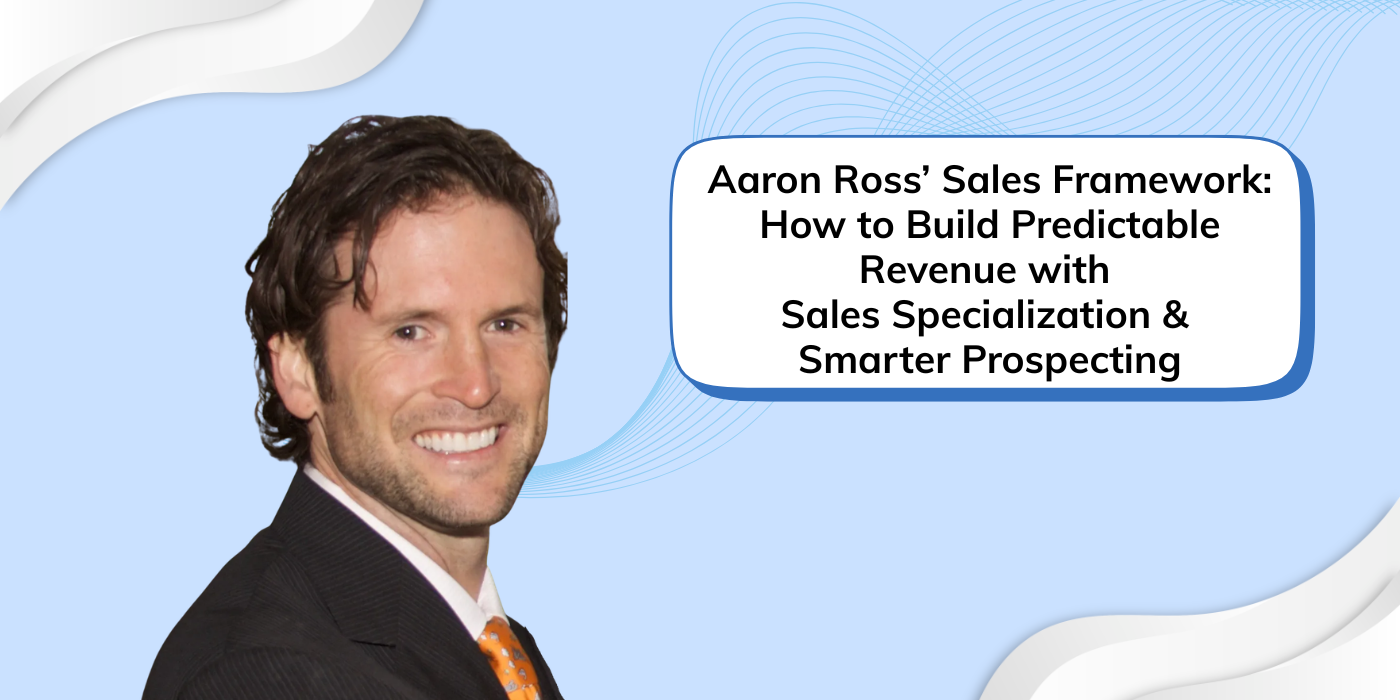
Aaron Ross - bestselling author of Predictable Revenue and From Impossible to Inevitable, international keynote speaker, and the architect of the outbound sales system that added over $100 million to Salesforce's revenue - joined host Steve Benson on Outside Sales Talk to make a case that challenges everything most sales organizations take for granted.
The problem isn't that your reps can't close. It's that you're asking them to do too many things at once and calling it a sales team.
Here are the biggest Aaron Ross sales insights distilled from the interview. Listen to the full Outside Sales Talk episode Why Salespeople Should STOP Prospecting with Aaron Ross or find it on Apple Podcasts, Spotify, Pandora, and YouTube.
Aaron Ross Insight #1 - How to Build a Specialized Sales Team That Generates Predictable Results
"When one salesperson is trying to prospect and close and manage customers, it's too much. It's inhuman to feel they'll do all that well. It's very rare to find someone who can do it all well. It's like the unicorn hire. You can't build a team around that."
Aaron's foundational argument is simple: the fastest-growing companies in the world - especially in Silicon Valley - don't ask their salespeople to do everything. They specialize. Just as a soccer team doesn't ask every player to both defend and score, a high-performing sales team assigns distinct roles to distinct people.
- The four core sales roles: Outbound prospectors who generate leads, inbound responders who handle marketing-generated leads, closers who sign new business, and customer success reps who manage post-sale relationships. Each role requires different skills, different metrics, and different people.
- Specialization creates repeatability: When people do fewer things, they do them better. A dedicated prospector becomes an expert prospector. A dedicated closer becomes a better closer. Trying to find one person who excels at all four functions is chasing a unicorn - and you can't build a scalable sales team around unicorns.
- You can't have predictable revenue without predictable lead generation: "If you have a predictable way to generate sales appointments, you will be able to create predictable sales." Specialization isn't just an efficiency play - it's the foundation of a system that produces consistent, forecastable results.
Why This Works: Every salesperson who's ever struggled to balance prospecting with closing knows the feeling - both suffer. Specialization removes that tension entirely, letting each person operate in their zone of highest contribution. The result isn't just more activity; it's better activity across every stage of the funnel.
PRO RESOURCE: For more on structuring a high-performing sales team and keeping reps focused on their highest-value activities, see Jeb Blount's 8 Time Management Secrets: Impactful Habits of Ultra-High Sales Performers.
Aaron Ross Insight #2 - How to Apply Specialization Principles Even When Your Team Isn't Ready
"If you can't get management to specialize your sales teams, take control of your calendar - block out time for whatever you need to do. I live and die by the calendar because that shows me my priorities."
Not every sales organization is ready to restructure. But Aaron is clear that the underlying principle - doing fewer things better - can be applied by any individual rep, right now, with nothing more than a calendar and some accountability.
- Block at least 90 minutes at a time for prospecting: A few minutes here and there won't cut it. Prospecting requires sustained focus, and that means protecting dedicated time on your calendar the same way you'd protect a meeting with your best customer.
- Get an accountability buddy: Aaron compares it to starting a new exercise routine - you need a time, a place, and someone who knows if you don't show up. A colleague who shares your prospecting block and checks in on results dramatically increases follow-through.
- Pre-qualify before you hit the road: For field reps, Aaron's advice is especially actionable - use phone and email to research and qualify accounts before you get in your car. "When you're actually out there in your car, which is very expensive on your time, how do you make sure you get the most out of that?" Preparation at home means fewer wasted visits and a higher-value day in the field.
Why This Works: Time is a field rep's scarcest resource. Every unqualified drop-in is a hidden cost - in miles driven, hours spent, and opportunities missed. Building structured prospecting time into your week - even just one focused block - creates the consistency that separates reps who hit quota from those who scramble at the end of every month.
Aaron Ross Insight #3 - How to Use the Referral Technique to Start Conversations Without Triggering Sales Defenses
"Hey, I hate to bother you, but I'm a little bit lost. Do you mind telling me - I'm not sure who to talk to here. Can you point me to the right person who handles X?"
Aaron calls this the referral technique - and it's one of the most disarmingly effective prospecting approaches in the entire interview. Whether delivered over the phone, by email, or in person, it opens doors that a direct sales pitch slams shut.
- Sound like a lost lamb, not a salesperson: "If you sound like, hey, I'm just a lost lamb - if you're on the street corner and you're like, hey, is there a gas station around here? That's the kind of tone." The moment your voice sounds like a pitch, defenses go up. Genuine curiosity keeps them down.
- Make friends with the gatekeeper: Stop trying to get through gatekeepers and start trying to win them over. An office manager or receptionist who likes you will give you a name, an email address, a phone number, and sometimes even an introduction. "Your gatekeeper can be your best friend."
- Use it to map the account, not just find the decision-maker: The referral technique doubles as a research call - you learn who's involved, how many locations there are, and whether this is even a fit before you invest further time. It's prospecting and qualification in one low-pressure conversation.
Why This Works: The traditional "get to the decision-maker" approach puts everyone on the defensive - the gatekeeper, the prospect, and sometimes even the rep. The referral technique removes the threat entirely. You're not selling; you're asking for help. And people are far more willing to help someone who seems genuinely lost than to buy from someone who seems obviously hungry.
PRO RESOURCE: For more on building trust and rapport from the very first interaction, see How to Close Sales with FBI Secrets: Chris Voss's Playbook.
Aaron Ross Insight #4 - How to Track the Right Metrics and Stop Measuring the Wrong Things
"People end up measuring prospectors on meetings booked, marketing on number of leads, and sales on revenue - and they're missing that key point in the middle where everything hinges."
One of Aaron's sharpest insights is about what most sales organizations measure versus what they should. The number that actually predicts future revenue - sales accepted leads, the qualified opportunities that salespeople actually take into their pipeline - is almost universally ignored.
- Separate your inbound and outbound funnels: Each has different metrics, different conversion rates, and different expectations. Lumping them together gives you a blended number that obscures what's actually working and what isn't.
- Measure sales accepted leads, not meetings booked: "If you're paying people on booking meetings, don't." A meeting that the salesperson doesn't accept as a real opportunity is worthless. The metric that matters is how many qualified opportunities actually enter the pipeline - and what dollar value they represent.
- Use qualified pipeline as your leading indicator: "If you can measure the amount of qualified pipeline being created every month, if that's going up or down - that is your leading indicator of future revenue, period." Everything else is a lag indicator or a vanity metric. Getting your sales performance tracking right starts here.
Why This Works: When everyone on the team - marketing, prospectors, and closers - is measured on the same key metric, the finger-pointing stops. Marketing can't claim success by generating a thousand leads that never enter the pipeline. Prospectors can't claim success by booking meetings that don't convert. Alignment around one shared number changes the entire dynamic of how a sales organization operates.
Aaron Ross Insight #5 - How to Define Your Ideal Outbound Customer Before You Prospect
"Step one, who's your ideal outbound customer that you want to go after? Which customers have been the easiest for you to close for the most money? This is where most companies and individual reps go wrong - they end up wasting a lot of time calling on the wrong companies."
Before any technique matters - referral method, email cadence, phone script - Aaron insists on one foundational step that most reps skip: clearly defining who they're actually going after.
- Start with your easiest, most profitable wins: Look back at your closed deals and ask - which ones closed fastest, for the most money, with the least friction? Those customers are your template. Build your prospecting list around companies that look like them, not around arbitrary firmographic criteria.
- Avoid the smallest accounts: "The smallest companies tend to actually be the most difficult. Just because they're scraping by, they need to get the most support for their dollars." Counterintuitive, but consistently true - smaller doesn't mean easier.
- Match your outreach channel to your market: Email works best for larger companies; phone and in-person work better for smaller businesses like dental or medical practices. "You have to experiment a bit for your kind of market to determine between phone, email, social, and in-person which works best." Know your market, then build your approach around it - not the other way around.
Why This Works: Prospecting without a clear ideal customer profile is the sales equivalent of fishing without knowing what fish live in the lake. Defining your ideal outbound customer first doesn't just improve your hit rate - it focuses your energy, shortens your sales cycle, and makes every other prospecting technique significantly more effective.
PRO RESOURCE: For more on identifying and targeting the right prospects from the start, see Mark Hunter: The Sales Hunter's 5 High-Profit Prospecting Strategies Every Outside Salesperson Needs.
Aaron Ross Insight #6 - How to Use the Layers of the Onion to Move Prospects Forward Without Scaring Them Off
"A lot of times when people don't know us, we often try to move too fast. It's like going on a date - you're just saying hi and going for the kiss. Give them smaller steps to get to know you a little bit."
Aaron's "layers of the onion" principle - also described memorably as "don't throw a pizza at a squirrel" - is one of the most practical frameworks in the entire conversation. It's about sequencing your asks in a way that matches where the prospect actually is in their relationship with you.
- Start with the smallest possible bite: If they know nothing about you, don't open with a demo request. Start with a 30-second elevator pitch. Then a brochure. Then a 15-minute demonstration. Each layer earns the right to the next - and each step feels manageable to the prospect.
- Let them take steps toward you: "You take one little bite and put it out there and let them take a step towards you. Then you put another bite, and another bite. Soon they're eating out of your hand." The goal is progressive commitment, not a single dramatic ask.
- Match the size of your ask to the depth of your relationship: A cold prospect and a warm prospect require completely different approaches. Going straight for the big ask with someone who barely knows you doesn't just fail - it poisons the relationship for future attempts.
Why This Works: Buyers don't make big decisions with people they don't know. Every premature ask - especially a demo or a proposal to someone who's barely heard of you - signals that you're more interested in your sales cycle than their comfort level. The layers of the onion approach builds trust at the prospect's pace, and trust is what ultimately closes deals.
Steve Benson Bonus - How to Maximize Every Hour You Spend in the Field
"Before you go visit prospects, try to do some outreach already over the phone and get those scheduled demos to use your time in the most effective way. Every unqualified drop-in is a hidden cost."
Steve draws on his experience at Badger Maps to highlight a truth that every field rep knows but not enough act on: time in the car is expensive, and most reps aren't protecting it the way they should.
- Plan your drop-ins alongside your scheduled meetings: Steve's recommendation is to set a daily goal - five scheduled meetings plus five intentional drop-ins along the route - rather than treating unplanned stops as a bonus. Structure beats spontaneity every time.
- Do your qualification work before you leave the office: Phone calls, emails, and research done at your desk determine whether a visit is worth making at all. Aaron reinforces this: "When you go out in the field, which is very expensive on your time, how do you make sure you get the most out of that?"
- Consider an inside support role for your team: Even one inside rep supporting four field reps - handling appointment setting, pre-qualification, and follow-up - can dramatically increase the quality of every meeting those four reps walk into.
Why This Works: Field sales is high-leverage when you're in front of the right people - and low-leverage when you're not. The reps who protect their windshield time by doing the hard qualification work beforehand don't just see more people; they see better people. That's what turns a busy day in the field into a productive one.
Final Takeaways
Aaron Ross's message is ultimately about building systems that work - not just people who work hard. Specialize your team so everyone can do fewer things better. Define your ideal customer before you prospect. Measure the right things. Use the referral technique to open doors without triggering defenses. And give every prospect the right-sized next step, not the biggest ask you can get away with.
Start this week by blocking 90 minutes on your calendar for prospecting - phone in hand, qualified list ready, no interruptions. Then find one colleague to hold you accountable. As Aaron puts it: "If you don't create that time, the techniques aren't really going to matter."
Who is Steve Benson?
Steve Benson is the founder and CEO of Badger Maps, the number one route planning app for field sales reps, and the host of the Outside Sales Talk podcast. A former field salesperson himself, Steve built Badger Maps to help outside sales teams spend less time driving and more time in front of the right customers.
Who is Aaron Ross?
Aaron Ross is the bestselling author of Predictable Revenue - co-written with Jason Lemkin and widely regarded as the definitive playbook for outbound sales - and From Impossible to Inevitable. He built the outbound sales system at Salesforce that contributed over $100 million in recurring revenue and has since helped hundreds of companies build scalable, predictable sales engines through his company Predictable Revenue, Inc.
What are Aaron Ross's books about?
Predictable Revenue lays out the outbound prospecting framework Aaron pioneered at Salesforce - covering sales role specialization, lead generation funnels, and the metrics that actually predict future revenue. From Impossible to Inevitable, co-written with Jason Lemkin, zooms out to the bigger picture of what it takes to build hyper-growth companies, including the mindset required to stay the course through the inevitable ups and downs of building something great. Both are essential reads for sales leaders and reps alike.
Where can I find more related sales strategies?
You can also download Predictable Revenue on Amazon or visit predictablerevenue.com for additional resources. You can reach Aaron at aaron@predictablerevenue.com. And of course, connect with Aaron on LinkedIn.
For more on building a smarter prospecting process and managing your sales pipeline effectively, check out Sales Prospecting: The Ultimate Guide and How to Build a Sales Strategy: The Ultimate Guide for Sales Teams.
The leading app for field teams
Badger Maps is a routing & mapping app that automates data collection and uplevels field team performance. From planning your day to managing your territories, Badger optimizes every aspect of the field sales process.
90-day money back guarantee
No set up fees.


Related
Looking for our logo?
Grab a Zip packed with our logo in PNG and EPS formats.