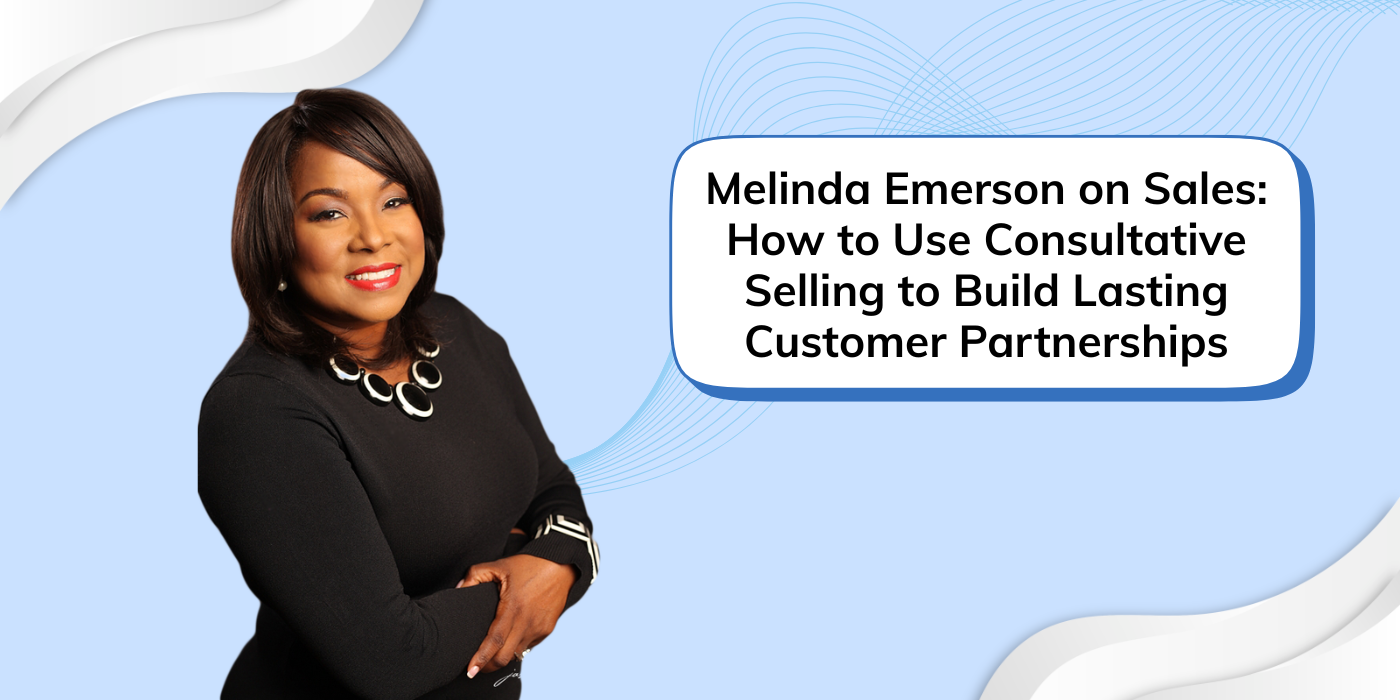
Melinda Emerson on Sales: How to Use Consultative Selling to Build Lasting Customer Partnerships
By Steven Dew
Posted in Career, Interviews, Relationship Management, Sales Tips
By Steven Dew
Posted in Career, Interviews, Relationship Management, Sales Tips
Consider this: Most salespeople are so focused on the next deal that they're quietly destroying the ones they already have.
Known as the Small Biz Lady and host of the SmallBizChat Podcast, Melinda Emerson joined host Steve Benson on Outside Sales Talk to share her philosophy on consultative selling. With 20 years of entrepreneurial experience and a client roster that includes Fortune 500 companies, Melinda makes a compelling case that the salespeople who win long-term aren't the sharpest closers - they're the ones who listen best, protect their customer relationships fiercely, and think two or three sales ahead.
Here are the biggest Melinda Emerson sales insights distilled from the interview. For more sales gold, listen to the full Outside Sales Talk episode Creating a Win-Win Solution with Consultative Selling with Melinda Emerson or find it on Apple Podcasts, Spotify, Pandora, and YouTube.
Melinda Emerson Insight #1 - How to Lead with Listening and Qualify with Integrity
"The worst thing we can do as salespeople is try to sell something when somebody's got a round hole and you got a square solution. You have to have enough integrity as a salesperson to be like, you know what, my solution - I don't know if it's really going to work for you."
Melinda's first principle of consultative selling isn't a tactic - it's a mindset. Before you pitch anything, your job is to find out where the customer's pain actually is. Only then can you honestly assess whether you have a solution worth offering.
- Listen before you launch: Don't open with your features or your offer. Ask questions, find the pain, and let the customer's answers determine whether there's a real fit - not your quota pressure.
- Qualify with honesty: Selling something that isn't a good fit might get you one sale, but it will cost you the relationship. As Melinda puts it, "you're only gonna make one sale" - and repeat business is where the real money is.
- Operate in your customer's best interest: Even when it's hard, even when you need to make your numbers. Customers who feel genuinely looked after come back - and they bring others with them.
Why This Works: Consultative selling only works when the customer believes you're on their side. The moment they sense you're pushing something that isn't right for them, trust evaporates - and so does the relationship. Integrity in qualification isn't just the ethical choice, it's the most profitable one.
PRO RESOURCE: For more on building the kind of authentic buyer trust that drives long-term relationships, see Andy Paul on Sales: How to Sell Without Selling Out and Build Authentic Buyer Connections.
Melinda Emerson Insight #2 - How to Map Decision Makers and Never Rely on Just One Door
"You don't just want to go in one door. You want to have at least three doors that you can go into - because even if it's not somebody that can buy from you, it's somebody who can give you information about who can."
One of the most common and costly mistakes in B2B sales is building a relationship with a single contact and assuming that's enough. People retire, quit, and get fired - and if your only relationship walks out the door, you effectively get fired too.
- Treat every account as a market: Think about how many opportunities you can develop within a single customer organization. Multiple relationships mean multiple sources of intelligence, multiple champions, and multiple safety nets.
- Navigate internal politics carefully: The person you're working with may feel threatened if you try to reach others in their organization. Melinda's advice: find ways to make them feel like the hero who brought your solution in, while still working to build broader relationships.
- Identify all the decision makers early: "Sometimes you think you're talking to the decision maker and you find out there's a VP, a director, or somebody that's got to get involved." The sooner you map the full buying committee, the smoother your sales process will be.
Why This Works: Single-threaded deals are fragile. Multi-threaded relationships create stability, accelerate consensus, and dramatically reduce the risk of a deal falling apart because one person left the company or changed their mind.
Melinda Emerson Insight #3 - How to Protect Your Customer Relationships After the Sale
"You make the sale and then you turn it over to an AE to execute. We got to be careful because that's still your relationship. And so you have to make sure that you have relationships up and down your own service line to make sure that your customers are being well taken care of."
Closing the deal is not the finish line - it's the starting gun on your most important responsibility. Melinda is emphatic that salespeople who hand off and move on are quietly destroying the relationships they worked so hard to build.
- Own the outcome, not just the sale: When something goes wrong in shipping, fulfillment, or execution, the customer calls you - not the department that made the mistake. Have a plan and a network inside your own organization to fix problems fast.
- Follow up within 7-10 days of delivery: "You need to ask for feedback within seven to ten days of a customer taking delivery." Don't wait for the customer to call you with a problem - call them first.
- Never let them find out before you do: The worst scenario is a customer calling to report a problem you didn't know about. Stay close enough to your accounts and your internal teams that you're always the first to know.
Why This Works: Customers have long memories. How you handle problems after the sale shapes their perception of you far more than how smoothly the sale itself went. Proactive follow-up turns potential disasters into trust-building moments - and those moments are what create repeat business.
PRO RESOURCE: For more on building the kind of customer relationships that drive retention and referrals, see Janice B Gordon Sales Relationships: How to Scale Your Sales Through Customer Retention and Referrals.
Melinda Emerson Insight #4 - How to Think Two or Three Sales Ahead to Win Long-Term Partnerships
"It's not about what you're selling them today. You're trying to figure out how you can position yourself to sell them something three years from now. So you want to learn, you want to listen, you want to understand what their problems are and what their growth trajectory is, what their product roadmap is."
Consultative sellers don't just solve today's problem - they study where their customer is going. Understanding a customer's future roadmap puts you in a position to be the obvious choice when their next need emerges, often before they've even started looking.
- Learn your customer's roadmap, not just yours: Most salespeople know their own product's future inside and out. Melinda challenges you to know your customer's future just as well - their expansion plans, their challenges on the horizon, their strategic priorities.
- Zig where others are zagging: When you understand where a customer is heading, you can position your solution to meet them there - before competitors even realize the opportunity exists.
- Think in terms of partnerships, not transactions: The goal isn't to close this deal. It's to become the vendor they can't imagine replacing - the one who's been thinking about their business as long as they have.
Why This Works: Buyers at every level are more likely to stay with a vendor who demonstrates genuine understanding of their business over time. Thinking ahead isn't just good strategy - it's the clearest signal you can send that you're a partner, not a peddler.
Melinda Emerson Insight #5 - How to Build Trust by Being More Interested Than Interesting
"When you first meet someone, you need to be more interested than interesting. We've got two ears and one mouth. That's because you're supposed to be listening - actively listening, not listening to wait for your turn to talk."
Trust in consultative selling isn't built through impressive presentations - it's built through genuine curiosity. Melinda's trust-building framework starts with a simple reframe: stop trying to impress and start trying to understand.
- Listen to connect, not to respond: Active listening means thinking about who else in your network might help this person, what their real problem is beneath the surface, and how you might make the pie bigger for everyone - not rehearsing your next talking point.
- Bring in resources beyond yourself: Melinda shares the example of pulling in a CFO to help a transportation company secure $60 million in financing to buy new train engines. The sale wasn't possible without solving the bigger problem first - and solving it created an unbreakable loyalty.
- Love on the assistants: "I send the assistant a gift just like I would send the person I'm targeting, because the assistant is the one that's really going to tell you how much time they really have." The people around your buyer are part of the relationship too.
Why This Works: People can tell the difference between someone who is genuinely interested in them and someone who is performing interest to close a deal. Authentic curiosity is disarming - it lowers defenses, opens conversations, and builds the kind of trust that turns a one-time buyer into a long-term partner.
PRO RESOURCE: For more on the human side of selling and the role of genuine connection in closing deals, see Neil Rogers on Sales: How Bartending Soft Skills Can Supercharge Your Sales Career.
Melinda Emerson Insight #6 - How to Focus on Existing Customers to Drive Sustainable Revenue Growth
"An existing customer is 60 to 70 percent more likely to buy than a brand new customer. Brand new customer, you're lucky if you close with them five to 20 percent of the time. Love on people who've already loved on you."
New leads get all the attention, but Melinda argues that chasing new customers at the expense of existing ones is one of the most common strategic mistakes in sales - at companies big and small.
- Split hunters and farmers intentionally: Dedicate specific reps to existing customer relationships and specific reps to new business. The skill sets are different, the comp plans should reflect that, and both functions are essential.
- Know who your farmers are: The rep who remembers the names of all the customer's kids, who builds five-year relationships, who is woven into the fabric of the account - that person is just as valuable as your best closer, and often more so for long-term revenue.
- Stay in touch even when you have nothing to sell: "Keep in touch even when you don't have anything to sell. You can't just let your database get cold." A quick check-in call or a handwritten note keeps you top of mind - and sometimes surfaces a need you didn't know existed.
Why This Works: The math is simple - upselling and cross-selling to existing customers costs far less and converts far better than acquiring new ones. Salespeople and sales leaders who build their strategy around existing customer growth don't just hit their numbers - they build revenue that compounds year over year.
Steve Benson Bonus - How to Align Sales and Marketing Around the Right Customer
"Getting those two groups [sales & marketing] to really understand one another and not have friction is definitely one of the big challenges. If miscalibrated, you so often see a marketing team pursuing leads that aren't the ones that are going to close - slightly the wrong industry, slightly the wrong customer."
Steve draws on his own experience building Badger Maps to highlight a systemic problem that quietly undermines entire sales organizations: when sales and marketing operate as separate silos, everyone loses.
- Bring sales and marketing into the same room: Melinda recommends pairing someone in marketing with a counterpart in sales to get real-time feedback on campaigns and messaging before anything goes out the door. Salespeople will tell you fast what isn't going to work.
- Understand the difference between an MQL and an SQL: Marketing qualified leads and sales qualified leads are not the same thing. When both teams understand what each other needs, lead quality improves - and salespeople stop wasting time on prospects that were never going to close.
- Quality of outreach beats quantity every time: Steve's observation from his own inbox: "It's really tough to make that work" when you're cold emailing 1,000 people. Thoughtful, targeted outreach to the right buyer - especially in person - will outperform spray-and-pray every time.
Why This Works: Sales and marketing misalignment is one of the most expensive and underdiagnosed problems in B2B organizations. When both teams share a clear picture of the ideal customer and talk to each other regularly, lead quality goes up, sales cycles shorten, and revenue stops leaking at the handoff.
Final Takeaways
Melinda Emerson's consultative selling philosophy comes down to one governing principle: always operate in your customer's best interest, even when it's hard. Listen before you pitch. Know your decision makers. Protect the relationship after the sale. Think ahead. Be genuinely curious. And never let your existing customers feel forgotten.
Start today by calling a customer you haven't spoken to in a while - not to sell them anything, just to check in. As Melinda puts it: "You never know, somebody might be like, wow, I'm so glad you called me, I need X." That's consultative selling at its most powerful - and its most human.
You can connect with Melinda directly on LinkedIn, listen to the SmallBizChat podcast, or follow her at @SmallBizLady on social media.
The leading app for field teams
Badger Maps is a routing & mapping app that automates data collection and uplevels field team performance. From planning your day to managing your territories, Badger optimizes every aspect of the field sales process.
90-day money back guarantee
No set up fees.


Related
Looking for our logo?
Grab a Zip packed with our logo in PNG and EPS formats.