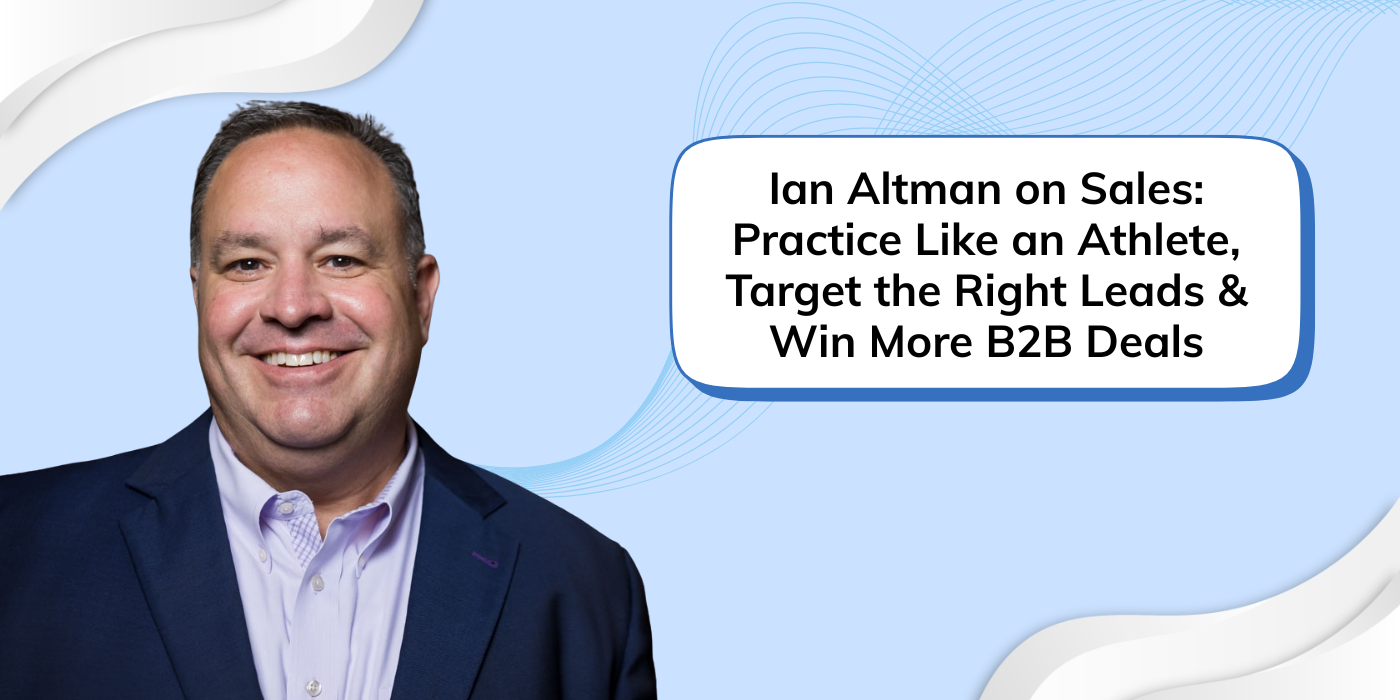
Ian Altman on Sales: Practice Like an Athlete, Target the Right Leads & Win More B2B Deals
By Steven Dew
Posted in Career, Interviews, Relationship Management, Sales Tips
By Steven Dew
Posted in Career, Interviews, Relationship Management, Sales Tips
Most salespeople lose deals long before they ever make their pitch - and they don't even know it.
Bestselling sales author and CEO Ian Altman joined host Steve Benson on Outside Sales Talk not once but twice. Across both conversations, Ian dismantled the "always be closing" mentality, revealed why elite salespeople need to train like athletes, and laid out exactly what B2B buyers are silently evaluating before they ever say yes.
Here are the biggest Ian Altman sales insights distilled from both interviews. Check out and listen to the full Outside Sales Talk episodes Targeting Leads That Actually Close with Ian Altman and Why Athletes Win: Tactics to Become a Sales Superstar with Ian Altman, or find them on Apple Podcasts, Spotify, Pandora, and YouTube.
Ian Altman Insight #1 - How to Show Up as a Problem-Solver, Not a Peddler
"You can show up in one of two ways. You can either show up as somebody who's there to sell something or someone who's there to solve something. And none of us likes to feel like we're on the receiving end of being sold to."
This mindset shift separates Ian's top-performing clients from everyone else. When your goal is to sell to anyone with a budget, it leaks into your body language and questions - and prospects shut down the moment they sense it. Ian calls this the "mushroom metaphor": they keep you in the dark and throw manure on you, and you're expected to grow.
- Reframe your goal before every meeting: Your objective isn't to close - it's to discover whether there's a genuine fit between the problems you solve and the challenges your prospect actually has.
- Watch for mushroom warning signs: If you're not getting honest answers or real dialogue, you're probably coming across as a seller, not a solver. Adjust immediately.
- Be willing to disqualify: Having "the humility and confidence to tell somebody they're not a fit" is one of the most powerful things a salesperson can do - those people often refer you to someone who is.
Why This Works: When you stop trying to sell to everyone, prospects lower their defenses and share real information. You stop wasting time on deals that were never going to close, and start building the trust that accelerates the ones that will - which is the foundation of any sustainable sales productivity strategy.
Ian Altman Insight #2 - How to Prospect by Leading with Problems, Not Products
"If I walk in and I talk about what my product or service does, I'm going to be at a supreme disadvantage because now I sound like a stereotypical salesperson."
Ian's prospecting philosophy starts with one pivot: stop leading with what you sell and start leading with the problems you solve. The moment you open with features and capabilities, the prospect categorizes you as a vendor to be screened out. Lead with the problems other clients like them bring to you, and you pique curiosity instead of triggering resistance.
- Replace "what I do" with "what problems I solve": Open with a problem statement, not a product pitch. For dental implant reps, Ian's example: "We work with dentists whose current provider isn't getting product to spec, missing deadlines, or getting the color wrong." That signals relevance instantly - or reveals there's no fit quickly.
- Close with a permission question: After naming the problems you solve, add: "If that's an issue you're facing, I'm happy to learn more to see if we can help." This hands the prospect control - which makes them more likely to engage.
- Think situationally, not demographically: Don't just target companies by size or revenue. Ask: is this organization growing? Facing a new industry challenge? Situational awareness beats demographic targeting every time and is the backbone of smart sales prospecting.
Why This Works: Leading with problems does two things simultaneously - it disarms the "I'm being sold to" reflex and creates immediate relevance for anyone who actually has that problem. Prospects who don't self-select out, saving you time. Prospects who do lean in on their own.
PRO RESOURCE: Want more on leading with authenticity and genuine buyer focus? Check out Andy Paul on Sales: How to Sell Without Selling Out and Build Authentic Buyer Connections.
Ian Altman Insight #3 - How to Disarm Prospects and Uncover What Their Current Vendor Is Missing
"I started by disarming by saying, 'Hey, we always like to get a sense of what other people are doing that maybe we're not doing but we should be doing. What are some of the things you like about your current vendor?' Then, 'What do you wish you could change?'"
In most field sales scenarios, your prospect is already buying from a competitor. Asking "are you happy with your current vendor?" is a trap - they'll say yes just to get you out of the office. Ian's approach reframes the entire conversation by positioning your questions as curiosity, not competition.
- Start with what they like: Asking what a prospect appreciates about their current vendor disarms defensiveness and gives you a roadmap of what you need to match or exceed.
- Follow with "what would you change?": This is where the real intelligence lives. Prospects will openly share frustrations when the question isn't framed as an attack on their existing relationship.
- Then ask if it's worth a conversation: "Is the potential of solving those issues worth a discussion about how we might be able to help?" You're not pitching - you're offering. That's a very different dynamic.
Why This Works: This sequence never puts the prospect on the defensive. You gather competitive intelligence, qualify fit, and create a natural opening for your value proposition - all without ever sounding like you're selling.
PRO RESOURCE: For a masterclass in asking questions that open doors instead of closing them, see John Barrows on Sales: Proven Techniques for Crushing Every Stage of the Sales Process.
Ian Altman Insight #4 - How to Build a Hyper-Value Case That Makes Price Irrelevant
"When it comes to selling what I call hyper value - the area where the client almost doesn't care about price - it requires mutual understanding about two things: the impact to the buyer if they don't solve the problem, and the value of the results if you get it right."
Price objections almost always mean the value hasn't been established yet. Ian's hyper-value framework turns price into a math problem the prospect solves alongside you - and knowing how to calculate ROI in sales before you walk in the door makes the answer obvious.
- Quantify the cost of the problem: Work with the prospect to calculate what their current situation is actually costing them. Ian's dental implant example: wrong colors and late deliveries could cost a dentist hundreds of thousands of dollars a year in rescheduled appointments and lost referrals.
- Quantify the value of the result: Establish what solving the problem is worth. If fixing the issue recovers $100K and generates another $100K in referrals, your solution is worth $200K - making a $20K price premium a non-issue.
- Make sure the salesperson believes it too: "If the customer understands it but the salesperson doesn't, the salesperson will still be concerned about selling the higher price." Both sides need to arrive at that number together.
Why This Works: When the prospect helps build the ROI case, they own it. You're not telling them your solution is worth the price - they're telling themselves. That's the difference between a buyer who haggles and a buyer who signs.
Ian Altman Insight #5 - How to Answer the Three Questions Every B2B Buyer Is Silently Asking
"No matter where they are in the world, no matter what size company they are, they ask the same three questions every single time."
Ian has run this exercise with over 10,000 CEOs and executives worldwide, asking them what they need to know before approving any significant purchase. The result is always the same - and if your sales process isn't built around these three questions, you're lengthening your sales cycle without knowing it.
- What problem does this solve? If you can't answer this in terms of their specific situation, nothing else matters. Buyers won't spend money on solutions to problems they don't believe they have.
- Why do I need it? The urgency and business impact question. Ian notes these first two are so intertwined that buyers often use them interchangeably - which is why your discovery process must address both.
- What's the likely result or outcome? This is the ROI question. The value of your solution lives in the gap between the cost of the problem and the value of the result. Nail this and the distant fourth question - "what are the alternatives?" - often answers itself.
Why This Works: Most sales processes are built around what the seller wants to say, not what the buyer needs to know. Aligning your conversations to these three questions means you're answering the exact criteria your prospect is already using to evaluate you - which shortens sales cycles and increases win rates.
PRO RESOURCE: For more on structuring your pitch around how buyers actually make decisions, see Brent Adamson & Karl Schmidt on Sales: How to Win More B2B Deals by Building Customer Decision Confidence.
Ian Altman Insight #6 - How to Practice Sales Like an Athlete and Outperform Your Peers
"In athletic competition, top performers are the people who consistently practice the most and work on their craft the most - except for, you guessed it, the people in sales."
Ian draws a direct line between athletic performance and sales performance - and the gap is practice. The batting champion isn't the player who practices least. The first chair in the orchestra isn't the musician who skips rehearsals. Yet in sales, people show up to high-stakes meetings having done zero preparation and tell themselves they'll "rise to the occasion."
- An hour a week is all it takes to outperform most peers: Ian references Malcolm Gladwell's 10,000-hour mastery research and points out that since most salespeople spend zero time practicing, even one hour a week puts you ahead of the pack.
- Stop making excuses: "I don't have time" really means "this isn't a priority." Ian's reframe: if practicing one hour a week saves you five hours in efficiency - which his audiences consistently confirm - the ROI is obvious.
- The teams that practice consistently win: Ian has watched the same pattern repeat across companies - the business unit that keeps practicing outperforms the one that stops. Every time. "Did their customer base change? No. Did their products change? No. They're just practicing."
Why This Works: Skills that feel uncomfortable in practice become natural under pressure. The salesperson who has rehearsed handling pricing objections, tough prospects, and curveball scenarios doesn't freeze when they encounter them live - they execute.
Ian Altman Insight #7 - How to Run a Sales Improv Session That Actually Makes You Better
"If you're not taking chances and if you're not making mistakes, then you're not learning anything."
Ian's Same Side Improv framework gives sales teams a structured, repeatable way to practice - without the awkwardness that makes most role-play sessions fall flat. The free tool is available at samesidesellingacademy.com, and the methodology is straightforward enough to model on your own.
- Use three roles every session: Salesperson, prospect/customer, and observer. The observer always learns the most - because they're not under pressure and can hear everything clearly. Rotate so everyone gets each role.
- Use "secret cards" to randomize the prospect: The Same Side Improv tool uses cards with different prospect attributes - "you don't trust vendors," "you're trying to get the cheapest price," "you're afraid to lose control" - so reps never practice the same scenario twice.
- Make feedback a one-way gift: After each round, observers share what they liked and one thing they'd suggest changing. The salesperson's only job is to say thank you - no defending, no explaining. "Just take their feedback, internalize it, and decide if it matters or not."
Why This Works: Traditional role-play fails because it's repetitive, embarrassing, and poorly structured. Same Side Improv solves all three problems - randomized scenarios keep it fresh, clear feedback rules remove the defensiveness, and the three-role structure ensures everyone learns something every single round.
Steve Benson Bonus - How to Calculate the Future Cost of Inaction
"I like to walk through someone and discuss, 'How much are you losing every month by not doing this?' It becomes almost like a future story of theirs."
When a prospect says "we love it, but now isn't the right time," Steve's approach is to make the cost of waiting impossible to ignore - not through pressure, but through math.
- Make the invisible visible: Walk prospects through exactly what delay costs them each month in lost revenue, wasted time, or missed opportunity. Abstract future loss becomes concrete present reality.
- Create their cautionary tale in real time: Help them write their own story of what the next six months looks like without your solution - making them the protagonist in a scenario they want to avoid.
- Combine calculation with narrative: Ian builds on Steve's approach: follow the numbers with a story about a client who was in the same situation, waited, and suffered the consequences. Logical and emotional urgency together is hard to dismiss.
Why This Works: "Maybe later" is the soft no that kills pipelines. When you help a prospect calculate their own cost of inaction - using their numbers, their situation - you're not being pushy. You're illuminating a blind spot. And that's exactly the kind of help that closes deals.
Final Takeaways
Ian Altman's core message across both conversations is simple: stop selling and start solving. Know the problems you solve better than anyone. Find the people who have those problems. Qualify ruthlessly, build your value case collaboratively, and practice your craft like the high-stakes professional you are.
Start with one step this week: spend an hour with a colleague running a Same Side Improv session using Ian Altman’s (free!) sales tool at samesidesellingacademy.com. Pick a real upcoming meeting as your scenario, rotate through all three roles, and commit to honest feedback. The teams that do this consistently don't just improve - they dominate.
Steve Benson is the founder and CEO of Badger Maps, the leading route planning app for field sales reps, and the host of the Outside Sales Talk podcast. A former field salesperson himself, Steve built Badger Maps to solve the real-world challenges he experienced on the road, and launched Outside Sales Talk to bring the world's top sales minds directly to the reps and managers who need them most.
For more on qualifying leads and building a smarter pipeline, check out Lee Salz's Sales Differentiation strategies and Mark Hunter's High-Profit Prospecting guide.
The leading app for field teams
Badger Maps is a routing & mapping app that automates data collection and uplevels field team performance. From planning your day to managing your territories, Badger optimizes every aspect of the field sales process.
90-day money back guarantee
No set up fees.


Related
Looking for our logo?
Grab a Zip packed with our logo in PNG and EPS formats.