Andy Paul on Sales: How to Sell Without Selling Out & Build Authentic Buyer Connections
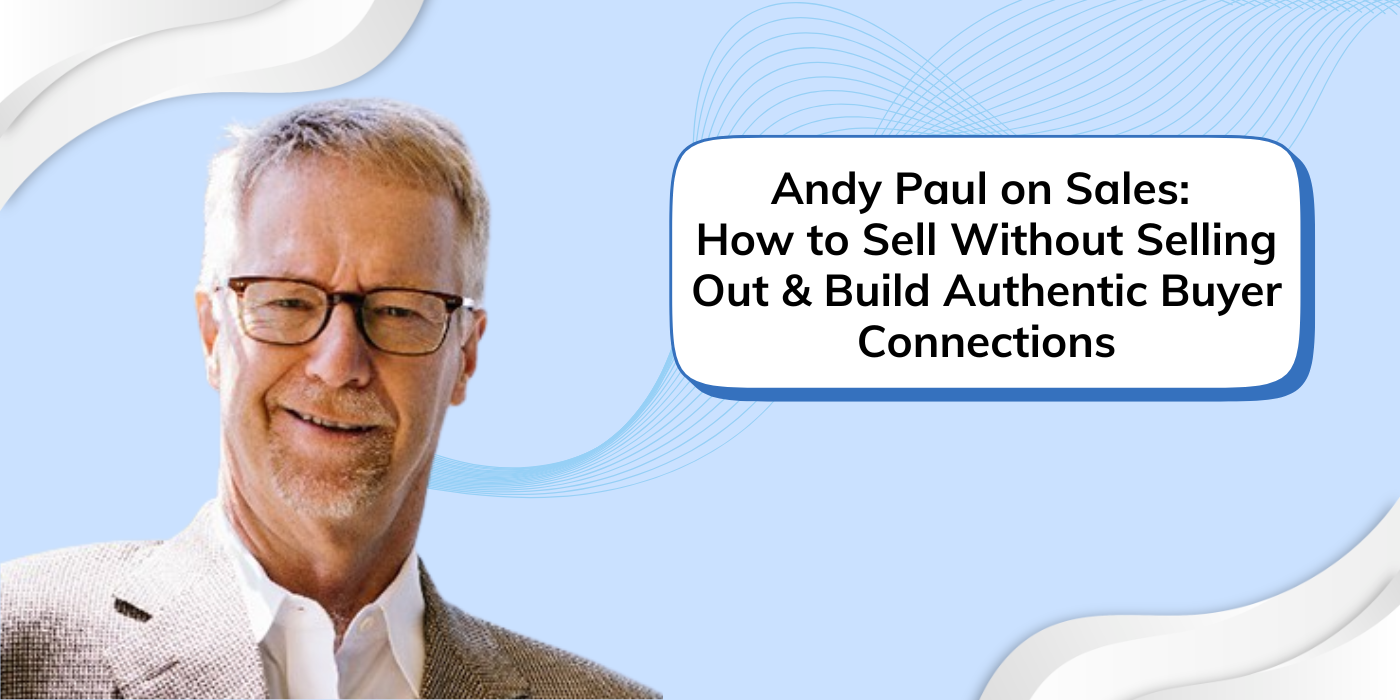
When Andy Paul joined Steve Benson on the Outside Sales Talk podcast to discuss his book Sell Without Selling Out, the conversation cut straight to one of the most persistent problems in sales: the gap between how salespeople are trained to act and how buyers actually want to be treated.
Andy has spent four decades in sales, hosted over 1,100 podcast episodes, and written three books - and his core argument is simple. The sellers who win long-term are the ones who stop performing and start connecting.
Here are the biggest Andy Paul sales insights from the interview. Listen to the full episode - Sell Without Selling Out with Andy Paul - on Apple Podcast, Spotify, Pandora, and YouTube.
Andy Paul Insight #1 - How Authenticity Becomes Your Biggest Competitive Advantage
"Your first impression on a buyer - if it's pushy, if you're playing a role - people see right through that. By being the authentic you, you come across as a human being, not somebody out there just to push a product."
Every salesperson walks into their first job carrying a mental image of what a seller is supposed to look like. Andy's argument is that shedding that image, rather than perfecting it, is what separates long-term performers from reps who plateau early.
- Cookie-cutter sales development produces cookie-cutter results: When managers lean too hard on conversational intelligence tools and top-performer call libraries, the wrong lesson emerges. "This is how Mike sells - do what Mike does" produces imitation. The right lesson: "This is what Mike does well - what can you take from that and integrate into your own selling?" Replication stifles growth. Experimentation drives it.
- Buyers decide based on their experience with the individual seller: In markets where competing products are functionally identical - which describes most of software - the buyer's experience during the sales process is often the deciding factor. The rep who shows up as a genuine person creates a differentiated experience the product alone can't provide.
- If you can't sell your way, find somewhere you can: Andy's advice to reps squeezed by rigid process mandates is direct: make the case for your approach, show results, and if the environment won't allow it, find one that will. "There are plenty of great sales managers who understand that their job is to help you become the best version of yourself."
Why This Works: Authenticity isn't a soft skill - it's a conversion driver. Buyers who sense they're being processed disengage. Buyers who feel genuinely understood keep talking.
Andy Paul Insight #2 - How to Answer the One Question Every Buyer Is Silently Asking
"Every customer is asking themselves: 'Why you? Why should I trust you?' They don't verbalize it - but they're thinking it. And you can't answer it with words. They have to experience you."
The "Why You?" question is the organizing principle of Sell Without Selling Out. Most salespeople try to answer it with credentials, company backgrounds, and feature lists - when the only thing that actually answers it is behavior.
- Preparation is the first signal: Showing up having done genuine research - LinkedIn, recent news, a Google search - signals that the buyer's time matters to you before you've said a word. It's the difference between walking in ready to have a conversation and walking in ready to deliver a presentation.
- The "ask five" rule: Challenge yourself to ask five questions about the buyer before saying anything about yourself. It's a trainable habit that rewires the instinct to pitch - and it works in sales for the same reason it works at a dinner party. People are wired to respond to genuine curiosity. The power of questions in sales is well-documented, and this is its most practical application.
- The answer is cumulative: It's not built in one moment - it's built across every touchpoint. Every time you show up prepared, lead with their agenda, and ask a question that proves you've been listening, you're adding to your answer.
Why This Works: In commoditized markets, the rep is the differentiator. The "Why You?" framework gives salespeople a concrete way to think about how they're building - or eroding - that edge in every interaction.
PRO RESOURCE: Answering "Why You?" starts with knowing more about your buyer than they expect. Read Brent Adamson and Karl Schmidt's insights on how to win more B2B deals by building customer decision confidence for a complementary look at what buyers are actually evaluating during the sales process.
Andy Paul Insight #3 - How to Use Discovery to Find "The One Thing" That Actually Drives the Deal
"Discovery is too often treated like a checklist. The goal should be to find what I call 'the one thing' - the most important challenge the buyer is trying to solve."
Most reps treat discovery as qualification - running through BANT or MEDDIC to confirm fit. Andy's point is that real discovery is how you earn the right to go deeper, and it only happens when the buyer trusts you enough to tell you what actually matters.
- Follow every answer with "what else can you tell me about that?" It's a simple prompt that signals genuine interest and consistently unlocks information the buyer hadn't planned to share. Surface-level questions produce surface-level deals - this one habit changes the depth of almost every conversation.
- Ask "what are we missing?" before you close discovery: When you think you've identified the key issue, that's exactly the moment to ask what's been overlooked. It often prompts the buyer to surface something they hadn't considered - and prevents the late-stage surprises that derail deals. This is sales communication as a competitive differentiator.
- Trust is the prerequisite: Buyers don't share their most important challenges with reps they don't trust yet. The preparation, the ask-five habit, the genuine curiosity - all of it exists to build enough trust that the buyer tells you the thing they wouldn't tell a rep they'd just met.
Why This Works: The depth of your discovery determines the strength of your close. A rep who has found "the one thing" and confirmed it with the buyer has a deal grounded in real impact - not just a well-delivered demo.
Andy Paul Insight #4 - How Impact Questions and a Co-Created Vision of Success Accelerate Decisions
"If you're the first seller to get the buyer to buy into your vision of success, you're 65% more likely to win the deal - and it can shorten the decision cycle too."
Once Andy has identified the buyer's key challenge, his next move is to quantify it - not through ROI calculators, but through questions that make the buyer do the math themselves.
- Ask buyers to quantify impact in their own terms: "What would it mean for your team if you were able to increase revenue by 5%?" forces the buyer to translate the problem into real business consequences. When a buyer articulates the cost of inaction in their own numbers, the urgency is theirs - not manufactured by the rep. This connects directly to how to calculate ROI in sales in a way that actually lands with buyers.
- Co-create the vision of success: The goal of impact questions isn't just to quantify pain - it's to get the buyer imagining what success looks like with your solution. A vision the buyer helped build is far more durable than one the rep presented to them.
- First-mover advantage is real: Forrester research cited by Andy shows that being the first seller to establish a shared vision of success produces a 65% higher win rate. Getting there first requires both speed and depth - you have to run discovery well enough, fast enough, to co-create that vision before a competitor does.
Why This Works: Buyers who have articulated their own problem and co-created their own vision of success aren't comparing vendors - they're making a decision. The rep who got them there has already won most of the deal.
PRO RESOURCE: Impact questions work best when you've already established the trust to go deep in discovery. Read Chris Voss's FBI negotiation playbook on How to Close Sales for a complementary look at how the right questions shift the psychology of a sales conversation.
Steve Benson Bonus - Why Staying Longer Is One of the Most Underrated Career Moves in Sales
"It's by staying a little bit longer that you truly understand the customer. You develop business acumen, understand how your customers use your product to make money, and that's what helps you grow in your career."
Steve's contribution pushes back directly against the job-hopping culture of modern tech sales - and the logic is grounded in what actually makes a salesperson more valuable over time.
- Domain expertise compounds in ways skills don't: A rep who has spent five years selling to dentists knows the buying cycle, the key objections, and the language of that world in a way that a rep off the street doesn't. Andy's framing: "At the laser company, you're worth a lot because of everything you know about the product, the market, and the customer. To the shoulder joint company? You're just another rep off the street."
- Short tenures cap career trajectory: Valley AEs averaging under a year create a pattern of lateral moves with no upward progression. "You may have been at five companies, but you're still at a junior level. You never progressed because you didn't stay long enough to move up." The career management insights that matter most come from depth, not breadth.
- The right time to leave is after you've gotten everything you can: Neither Steve nor Andy argues against changing jobs. The question is whether you've gotten the mentorship, the complex account experience, and the growth the role had to offer. If you have - move on. If you haven't - stay until you do.
Why This Works: Sales is a craft, and craft requires time. The rep who stays long enough to truly understand their customer doesn't just sell more - they become someone buyers specifically want to work with.
Final Takeaways
Andy Paul sales insights come down to a reorientation of what selling is actually for. It's not about executing a process - it's about earning trust, finding the one thing that matters to this specific buyer, helping them see what success looks like, and staying in this work long enough to get genuinely good at it.
The "Why You?" question never stops being asked. Every interaction is either answering it or eroding it.
Who is Steve Benson?
Steve Benson is the founder and CEO of Badger Maps, the leading route planning and territory management app for field sales reps. He hosts the Outside Sales Talk podcast, where he interviews top sales experts to bring actionable strategies directly to salespeople in the field. Steve was also named a LinkedIn Top Sales Voice.
Who is Andy Paul?
Andy Paul is one of the most recognized voices in sales, with over four decades of experience and more than 1,100 episodes of his Sales Enablement podcast. He is the author of three books, including Sell Without Selling Out: A Guide to Success on Your Own Terms.
What is Sell Without Selling Out about?
Sell Without Selling Out makes the case for a buyer-first approach to sales built on authenticity, genuine curiosity, and putting the buyer's interests ahead of quota pressure. It covers why so many salespeople default to manipulation and pressure tactics - and what it looks like to build a career on trust instead. Available wherever books are sold.
Where can I find more related sales strategies?
For more on Andy Paul's work, visit andypaul.com, reach him at andy@andypaul.com, or connect with him on LinkedIn.
For more on building authentic buyer relationships and winning through discovery, read our guide on consultative selling and discover effective sales techniques: how to be persuasive in sales.
The leading app for field teams
Badger Maps is a routing & mapping app that automates data collection and uplevels field team performance. From planning your day to managing your territories, Badger optimizes every aspect of the field sales process.
90-day money back guarantee
No set up fees.


Related
Looking for our logo?
Grab a Zip packed with our logo in PNG and EPS formats.