John Barrows on Sales: 5 Proven Techniques for Crushing Every Stage of the Sales Process
By Steven Dew
Posted in Interviews, Motivation, Presentations, Sales Process
By Steven Dew
Posted in Interviews, Motivation, Presentations, Sales Process
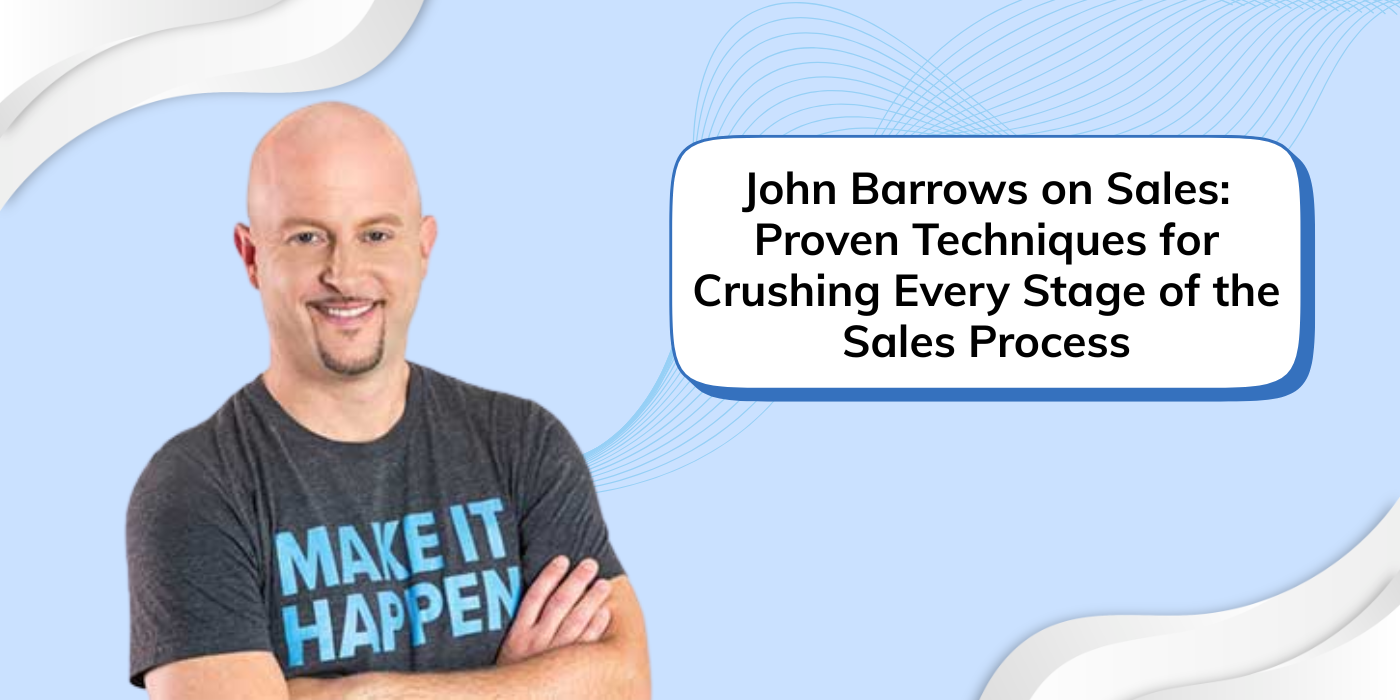
When John Barrows joined Steve Benson on the Outside Sales Talk podcast, he delivered a full-funnel teardown of where most salespeople quietly lose deals - and what to do about it.
As the founder of JBarrows Sales Training, a LinkedIn Top Sales Voice, and contributor to Forbes and Salesforce, John's core message is consistent: the fix is less about technique than it is about giving a damn.
Here are the biggest John Barrows sales insights from the interview. Listen to the full episode - Proven Techniques for Crushing Every Stage of the Sales Process - on Apple Podcast, Spotify, Pandora, and YouTube.
John Barrows Insight #1 - How to Build a Tighter Ideal Customer Profile by Dissecting Your Best Existing Customers
"Go find your top five or six customers that are doing really well right now. Dissect the hell out of them - not just industry, size, employees. What does their tech stack look like? Who do they sell to? What stage of business are they at?"
Most ICPs are too broad to be useful. The market shifts constantly, and the profile that worked two years ago may be quietly sending reps after companies that are no longer viable.
- Look downstream, not just at your customer: When SaaS began contracting, John didn't abandon the vertical - he started examining who his SaaS customers sold to. A SaaS company selling into other SaaS companies became a red flag. One selling into non-SaaS industries stayed on the list. Understanding a customer's customer is part of qualifying viability, not just fit.
- Tier your accounts ruthlessly: Tier ones precisely match the realized ICP. Tier twos are good but not great. Tier threes are filler. Knowing which tier you're working determines how much time you invest in personalization. This kind of territory management discipline is what separates focused reps from ones spinning their wheels.
- Use cold calls to gather ICP intelligence: The primary goal of a cold call is a meeting. The secondary goal is one extra data point. John's example: asking a gatekeeper whether the company uses Salesforce before leaving a voicemail. That answer, logged across a territory, eventually produces a filtered list where every subsequent call is more targeted.
Why This Works: Relevance beats personalization. A tighter ICP means every outreach starts from a more informed position - which is the foundation of every other technique in this conversation.
John Barrows Insight #2 - How to Sell to the 20% That Actually Matters to Each Persona
"Every client, every persona you're talking to, does not care about your entire solution. They only care about the part that's most relevant to them - that 20%. Our job is to find it."
Most reps who engage multiple stakeholders still bring the same pitch to every room. John's "Sell to the 20%" framework maps each persona to the slice of your solution most relevant to their role - and leads with that.
- Relevance trumps personalization: Knowing biographical details about a prospect is worthless if you can't connect them to something that matters to their job. Generic discovery questions - "tell me about your business," "how'd you get to where you are?" - are not just lazy; John calls them disrespectful. They burn the prospect's most valuable asset - time - on questions a five-minute LinkedIn search would answer.
- Research priorities before every call: Use AI or a simple Google search - "CFO, financial services, priorities, challenges, 2023" - before engaging any new persona. Better yet: pull job descriptions on Indeed for that role in that industry. Every KPI listed is a question you can ask and a value prop you can build. This is sales intelligence applied at the individual call level.
- Run a Q&A with your best existing customers: John's most underleveraged recommendation - a one-hour session with three customers who match the persona you're targeting. Ask what keeps them up at night, how they like to be communicated with, and what was the last prospecting outreach they ever responded to. Build your messaging from those answers, not marketing battlecards.
Why This Works: Finding the overlap between what matters to the economic buyer, the technical buyer, and the decision-maker is what makes a pitch feel like a conversation. It's the foundation of relevant B2B sales at every stage.
PRO RESOURCE: Selling to the right 20% starts with knowing what each persona actually cares about. Read Lee Salz's insights on Sales Differentiation: 6 Fresh Ways to Turn First Meetings into "When Can We Talk Again?" Moments for a complementary framework on leading with relevance from the very first interaction.
John Barrows Insight #3 - How to Present Without Pitching - and Why "Digest" Is the Worst Word You Can Hear
"As soon as the sales rep goes into presentation mode, the client goes into presentation mode. They go from leaning in to sitting back, crossing their arms, and waiting for your pitch."
John walked out of a presentation once convinced he'd crushed it. His engineer's silent look told him otherwise. That was the day he threw away his slide deck. The goal of a presentation isn't to inform - it's to help the prospect arrive at their own decision.
- Never open with company background: Spending the first five to ten minutes on founding year, headcount, and award logos - what John calls "puking" - signals the next 40 minutes will be about the rep, not the prospect. Start with what you know about them: market situation, challenges, impact. If they nod, you've earned the rest of the meeting.
- Ask the room what they want before you start: "What's the one thing you want to get out of this presentation?" - asked of every person in the room - forces real-time adaptation, ensures every stakeholder feels heard, and creates callbacks throughout: "Steve, you mentioned this was a priority; here's how we address it."
- Replace "does that make sense?" with better questions: "Could you give me an example of how this compares to what you're doing now?" or "How do you see this fitting into your existing workflow?" tells you far more about whether the solution lands - and keeps the conversation alive. These are the sales communication habits that separate top performers from average ones.
- Take the slides down: Periodically removing the deck - in person or remote - forces engagement and signals the conversation matters more than the content.
Why This Works: "Digest" is the tell. If a prospect needs time to process, the presentation failed. A presentation structured around their stated priorities, anchored in discovery, and delivered as a conversation doesn't produce digest. It produces a decision.
John Barrows Insight #4 - How to Handle Objections Proactively, Strategically, and With a Question
"The best reps respond to an objection with a question 53% of the time. Average reps do it 31% of the time. As an absolute default - ask a question."
John draws a hard line between objections without context (cold outreach) and those with context (mid-to-late funnel). Both share the same failure mode - a rep who reacts emotionally, defaults to a discount, and loses a deal they could have saved.
- Write down objections word-for-word for one week: Not "budget objection" - the actual words used. "We don't have budget" and "we're on a budget freeze" and "we're spending in other areas" are three different objections requiring different responses. Once you've catalogued the most frequent, find two or three handling techniques for each and A-B test them across your next 20 conversations.
- The summary email is your best mid-funnel tool: After any substantive discovery call, send a brief recap - current situation, priorities, timelines - and ask the prospect to confirm accuracy. Response rate is 20-25%, but John closes at roughly 90% with those who respond, versus 32% with those who don't. Decision-makers respond because confirming is efficient. People below the power line avoid it because they don't want to commit in writing. The response itself is a qualification signal.
- Use video when an objection arrives by email: A short video - summary email on screen, bubble-head in the corner - saying "I'm a little confused, because you confirmed your main priority was X, and now it looks like things have changed - can we get a few minutes to reset?" takes response rates from near zero to roughly 10%. That's not a win rate. It's a re-entry rate. But re-entry is all you need.
Why This Works: Objections are almost always questions in disguise. "You're too expensive" means the value case isn't closed. The rep who responds with a discount answered the wrong question. The rep who responds with "compared to what?" started the real conversation.
PRO RESOURCE: Proactive objection handling is most effective when it's built into the presentation itself. Read Victor Antonio's insights on how to Master Your Sales Presentations and Close More Deals for a complementary framework on blocking objections before they become positions.
John Barrows Insight #5 - How to Close on Impact, Not Timeline - and Get a Real Decision Meeting
"How hard can you push to close a deal? It's in direct proportion to how much it is in your best interest versus their best interest."
If you haven't established the real cost of inaction, you have nothing to push on. Reps chasing end-of-quarter closes without impact are just chasing commission. Reps who have quantified what non-action costs the business can push as hard as they want - because the urgency belongs to the prospect.
- Hunt for the dollar value of the problem: John's lost deal story makes this concrete. He discovered a discounting problem, identified the pain, and went into demo mode - without asking what the average discount rate was or what the net new revenue target was. A 20% discount rate on $100M in revenue is a $20M problem. "The difference between selling you how I can impact discounting versus how I can solve a $20 million problem - that is a much better conversation."
- Pipeline is the ultimate closing tool: A rep who needs the deal sells differently than one who wants it. Needing produces discounts and pressure. Wanting produces the right questions and closes on the prospect's timeline. "The biggest cure is a big fat pipeline." It's why sales prospecting never stops regardless of career stage.
- Schedule the decision meeting explicitly: When a prospect says they'll decide by Friday: "Great - when do you want to schedule a call so I can get a yes or a no from you either way? It's completely okay to tell me no - this way we don't have to play chase." Prospects who agree to that call close at 90%-plus. Those who don't: 25-30%. Willingness to commit to the call is itself a closing signal.
Why This Works: When the prospect has agreed on the cost of inaction, the close is a logical next step - not a pressure play. And when both parties know a decision is coming on a specific day, everyone shows up prepared to make one.
Steve Benson Bonus - Why You Can't Teach the "Give-a-Shit Factor" and Why It's the Most Important Hire You'll Make
"Sales is the transfer of enthusiasm. If you believe in what you sell and you've found the right ideal customer profile - it's just about finding those people and transferring that enthusiasm."
John asked Jack Welch directly how to instill passion in a new hire who didn't have it. Welch told him he was looking at it all wrong: "You can't teach passion. You have to hire for it." That answer changed John's entire hiring philosophy - and it's the lens through which Steve frames the whole conversation.
- Skill is teachable. Drive isn't. Technique, market knowledge, objection handling - all of it can be trained. The give-a-shit factor cannot. The skills a sales manager needs most include recognizing that distinction before making a hire.
- Give reps a personal reason to care about each account: Before putting a company on a top 25 target list, John asks reps to find one personal reason they want to work with that company - mission, product, leadership, something. The rep with a genuine connection asks better questions and shows up differently. The rep just hitting a cadence is detectable - and prospects detect it.
- Belief in the product is non-negotiable: If you don't believe in what you're selling, find a product you can believe in. The reps who transfer enthusiasm aren't performing - they're genuinely convinced the prospect is better off for having talked to them.
Why This Works: The give-a-shit factor determines whether every other technique in this conversation gets used well or goes through the motions. Without genuine curiosity and conviction, even the best frameworks produce demos that end with "I need some time to digest this."
Final Takeaways
John Barrows sales insights run top to bottom - tighter ICP, more relevant persona pitches, presentations that feel like conversations, objections handled before they become positions, and closes anchored in impact rather than timeline. Underneath all of it is the give-a-shit factor that makes every technique work the way it's supposed to.
Discovery isn't a phase. It's everything.
Who is Steve Benson?
Steve Benson is the founder and CEO of Badger Maps, the leading route planning and territory management app for field sales reps. He hosts the Outside Sales Talk podcast, where he interviews top sales experts to bring actionable strategies directly to salespeople in the field. Steve was also named a LinkedIn Top Sales Voice.
Who is John Barrows?
John Barrows is the founder of JBarrows Sales Training, providing sales training and consulting to companies and individuals worldwide. He is a LinkedIn Top Sales Voice, a regular contributor to Forbes and Salesforce, and the host of the Make It Happen Mondays podcast.
What does JBarrows Sales Training focus on?
JBarrows Sales Training covers the full sales process - from ICP development and prospecting through discovery, presentation, objection handling, and closing - with an emphasis on practical, testable techniques and treating discovery as a continuous activity rather than a single stage.
Where can I find more related sales strategies?
For more on John Barrows' work, visit jbarrows.com or follow him on LinkedIn and Instagram.
For more on building a high-performance sales process, read our guide on how to build a sales strategy, explore the 22 best sales techniques, and discover how to become a top sales performer.
The leading app for field teams
Badger Maps is a routing & mapping app that automates data collection and uplevels field team performance. From planning your day to managing your territories, Badger optimizes every aspect of the field sales process.
90-day money back guarantee
No set up fees.


Related
Looking for our logo?
Grab a Zip packed with our logo in PNG and EPS formats.