Anthony Iannarino on Sales: How to Outsell Your Competition by Creating Level Four Value
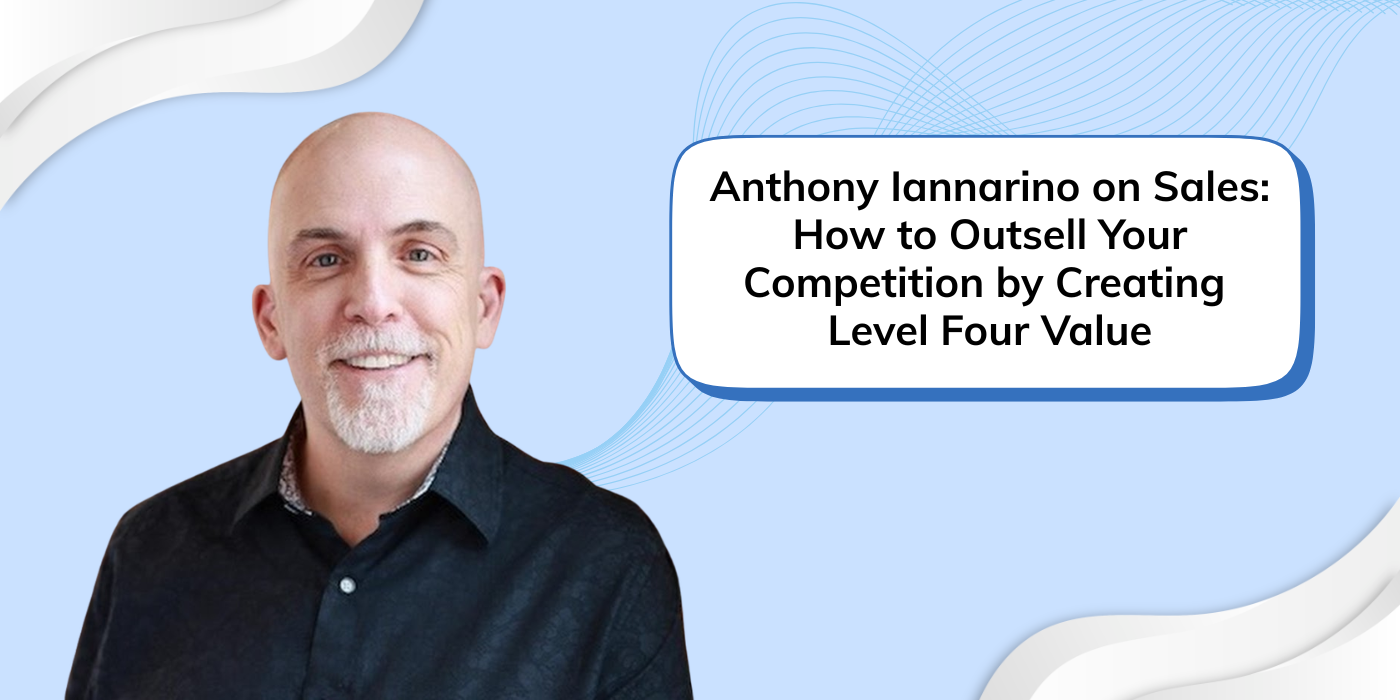
When Anthony Iannarino joined Steve Benson on the Outside Sales Talk podcast, the conversation went straight to a problem most sales organizations won't admit they have: they've stopped preparing to compete.
Anthony is a bestselling author, international speaker, and the founder of The Sales Blog - one of the most widely read sales resources in the world. His book Eat Their Lunch is built entirely around competitive displacement, and his argument is simple: sales is a zero-sum game, and the reps who pretend otherwise are the ones losing.
Here are the biggest Anthony Iannarino sales insights from the interview. Listen to the full episode - Best Ways to Deal with Competition in Sales with Anthony Iannarino - on Apple Podcast, Spotify, Pandora, and YouTube.
Anthony Iannarino Insight #1 - How to Compete Without Obsessing Over Your Competitor
"You can't do anything about your competitor. There's nothing you can do about them. So the healthiest way to look at competition is to work on you - become the best version of yourself, create greater value, and serve them better."
Anthony's competitive philosophy starts with a counterintuitive premise: the more you focus on your competitor, the less competitive you become. The energy that goes into watching, worrying about, and reacting to what competitors are doing is energy not going into the only thing that actually wins deals - becoming better yourself.
- Sales is a zero-sum game and most reps forget it: Anthony's framing is direct. In most markets, you win and your competitor loses, or they win and you lose. "Most of us live in the bloody red part of the ocean where we have to win and somebody else has to lose." Treating sales like clocking in and clocking out - going through the motions without preparing to compete - is the single biggest gap he sees across sales organizations. Understanding that B2B sales is fundamentally competitive changes how you approach every client interaction.
- You can't stop competitors from competing aggressively: Anthony's story is instructive - a competitor sent a savings analysis letter to every member of his largest client's executive leadership team, promising to save them half a million dollars. He couldn't stop it. He couldn't complain about it. All he could do was demonstrate that the value he was creating was worth more than the savings. He retained the client because he was irreplaceable, not because he out-maneuvered the competitor's move.
- Watch competitors closely - then focus on yourself: The distinction Anthony draws is between intelligence and obsession. You should know what your competitors are doing, how they're competing, and what they're doing differently that's worth modeling. But beyond that, they're not worth worrying about. "All you can do is decide: I'm going to become the best version of me that I can."
Why This Works: The rep who spends their energy becoming more knowledgeable, more trusted, and more valuable to their clients builds a competitive advantage that's genuinely hard to displace. The rep who spends their energy reacting to competitors is always playing defense.
Anthony Iannarino Insight #2 - How to Differentiate Yourself Without Trashing the Competition
"I never want to single out one competitor. I say: the industry tends to think this is the right answer. We think this is a better answer - and here's why. Then I'm differentiating."
Differentiation done wrong sounds like a competitive attack. Differentiation done right sounds like a perspective - a point of view on how things should work and why it produces better outcomes for the client.
- Name your price premium upfront: Anthony's opening move in competitive situations is to get price off the table immediately - not by defending it, but by acknowledging it and reframing it. "There are a lot of people that are going to have a lower price than we do. Our price is going to be about 8% higher than theirs in most cases. What I'd like to do is explain the difference in how we perceive the business." This approach disarms the price objection before it becomes one and immediately shifts the conversation to value.
- Contrast yourself against the industry, not individual competitors: Singling out a specific competitor by name puts you in attack mode and makes you look insecure. Contrasting yourself against "what the industry typically does" lets you make the same point - we do this differently and better - without the defensiveness. It also positions you as a thought leader rather than a rival.
- The goal is to contrast, not to criticize: Anthony is clear that you can reference competitors only insofar as it helps you explain your own differentiation. The moment you start criticizing them, you've shifted the conversation from your value to their weakness - and buyers notice the difference.
Why This Works: Buyers who feel like they're being sold against someone are on guard. Buyers who feel like they're being shown a better way of thinking about their problem are open. Differentiation framed as perspective rather than attack keeps the buyer leaning in.
PRO RESOURCE: Differentiation starts with how you show up in the first meeting. Read Lee Salz's insights on sales differentiation and how to turn first meetings into "when can we talk again?" moments for a tactical framework on making your approach the reason clients choose you.
Anthony Iannarino Insight #3 - How the Best Salespeople Are Getting Pulled in Two Directions - and Which One Wins
"Markets are getting pulled toward super transactional and super relational. The people in the middle are getting pulled down toward transactional - and that's the easiest race to lose, because there's always someone willing to go lower."
Anthony's market dynamics framework is one of the most clarifying ideas in the conversation - and the most urgent for field sales reps whose products are increasingly available online at lower prices.
- The Amazonification trap is real: Amazon's entire model is built on removing friction from transactions. They want no salespeople if they don't need them. Any rep who competes primarily on convenience, speed, or price is competing on Amazon's terms - and losing. The field sales rep who shows up and offers the same product available online for less, with no additional value, has already lost before the conversation starts.
- Super relational is the winning direction: Anthony cites Travel Counselors in Manchester - a live travel agency growing at 12-15% annually while the rest of the industry shrinks by going transactional. Their competitive advantage: they know their clients, they care about their clients, and when something goes wrong, they fix it. "It's hard for the internet to compete with someone who knows me, who cares about me, who's going to make sure everything is exactly right." This is the face-to-face sales advantage that field reps can build and digital channels structurally cannot.
- Efficiency in human relationships is the wrong goal: Anthony's observation cuts against a lot of modern sales thinking: "You don't want efficiency in human relationships. You want effectiveness. Even though an email is easier than having a conversation, the face-to-face conversation creates greater value, greater intimacy, and a greater preference to work with you." Automating communication instead of investing in it is the trap that pulls reps toward the transactional pole.
Why This Works: In a world where any product can be purchased online, the rep is the differentiator - not the product. The reps who build deep, caring, high-trust relationships are competing in a category of one. The reps who compete on price and convenience are competing against everyone, including the internet.
Anthony Iannarino Insight #4 - How to Reach Level Four Value and Become Impossible to Displace
"You get to Level Four Value. You find the business acumen and situational knowledge that makes you a trusted advisor. And then you start shaping the client's mindshare - giving them a new lens so they see new opportunities and new challenges. The person who creates the opportunity and builds consensus around it is preferred."
Level Four Value is Anthony's framework for the highest form of competitive advantage available to a salesperson - and it's the answer to every commoditization threat in the market.
- The four levels move from product to strategic: Anthony's framework progresses from product/service value (what you sell) to execution value (how reliably you deliver) to business value (the measurable impact on their business) to strategic value - level four - where you become part of how the client thinks about their future. At level four, you're not responding to RFPs. You're creating the opportunities that generate them.
- Caring is the killer app: Anthony's answer when asked for the single most critical sales trait: caring. "Caring about other people and caring about helping other people is the killer app. When people know you care about them, when you have intimacy, they understand you're trying to help them build a competitive advantage." Business acumen without caring is consulting. Caring without business acumen is rapport. The combination is trusted advisor - and that's the only position that's genuinely hard to displace. This connects directly to becoming a top sales performer - it's never just about skill, it's about how much you actually invest in the people you serve.
- You don't get to call yourself a trusted advisor: Anthony's observation is worth repeating: "All salespeople say they want to be a trusted advisor. I see some people put it on their LinkedIn. You don't get to say that. Somebody else says that about you." Trust is earned through advice. Advice requires genuine business acumen and situational knowledge. Without the advice component, you have trust but no leverage - and a client who likes you but doesn't need you.
Why This Works: Level four value creates preference that price can't undo. When you're the person who helped a client see a problem they didn't know they had, and then helped them build consensus internally to solve it, you didn't just win a deal - you created the deal. That's a competitive position no competitor can easily copy.
PRO RESOURCE: Reaching level four value requires the kind of discovery that goes well beyond surface questions. Read Brent Adamson and Karl Schmidt's insights on how to win more B2B deals by building customer decision confidence for a complementary framework on how the best salespeople shape - not just respond to - the way buyers think.
Steve Benson Bonus - Why 90-Minute Focused Blocks Are the Productivity Hack That Actually Changes Careers
"If you give something 90 minutes of full focus and attention three times a day, you will be amazed at how much work you can actually do. Focus is the currency of results and success - and the reason so many people struggle is that they're distracted by so many things."
Steve's exchange with Anthony on productivity lands on what is arguably the most actionable takeaway in the conversation - and the one most field reps will recognize as the thing they're not doing.
- Three 90-minute blocks equals four and a half hours of real work: Anthony's daily structure - prospecting for 90 minutes, follow-up for 90 minutes, deep work for 90 minutes - with full distraction elimination (browser closed, notifications off, no interruptions) produces more output than most people generate in a full eight-hour reactive day. The math is hard to argue with.
- Start your first block at 5:30 AM: Anthony's reasoning is practical: "No one in the world wants your time at 5:30." The first block of the day, done before the inbox opens and before anyone can claim your attention, is the most protected and most productive. It's also the block most likely to compound - the rep who prospects for 90 uninterrupted minutes every morning before the day begins is building pipeline that the reactive rep never touches.
- The secret to productivity is doing what's most important until it's complete: Anthony's distillation: "The only secret to productivity is do what's most important until you complete it. You can be really busy and not productive." Email is the most common trap - every reply generates two more, the war is unwinnable, and it's real work that crowds out the most important work.
Why This Works: Most sales productivity problems aren't motivation problems - they're focus problems. The rep who protects three 90-minute blocks per day and fills them with the highest-leverage activities available has a structural advantage over every distracted competitor in their market.
Final Takeaways
Anthony Iannarino sales insights come down to one through-line: the rep who creates the most value wins. Not the rep with the lowest price, the flashiest product, or the most aggressive tactics - the one who cares enough to understand the client's business deeply, honest enough to show up as a peer rather than a vendor, and disciplined enough to build the trust that makes them genuinely difficult to displace.
The market is pulling in two directions. The reps who survive - and thrive - are the ones who choose the relational pole deliberately, invest in it daily, and compete at level four while everyone else races to the bottom.
Steve Benson is the founder and CEO of Badger Maps, the leading route planning and territory management app for field sales reps. He hosts the Outside Sales Talk podcast, where he interviews top sales experts to bring actionable strategies directly to salespeople in the field. Steve was also named a LinkedIn Top Sales Voice.
The leading app for field teams
Badger Maps is a routing & mapping app that automates data collection and uplevels field team performance. From planning your day to managing your territories, Badger optimizes every aspect of the field sales process.
90-day money back guarantee
No set up fees.


Related
Looking for our logo?
Grab a Zip packed with our logo in PNG and EPS formats.