News: Now offering SSO.
Learn more
News: Now offering SSO.
Learn more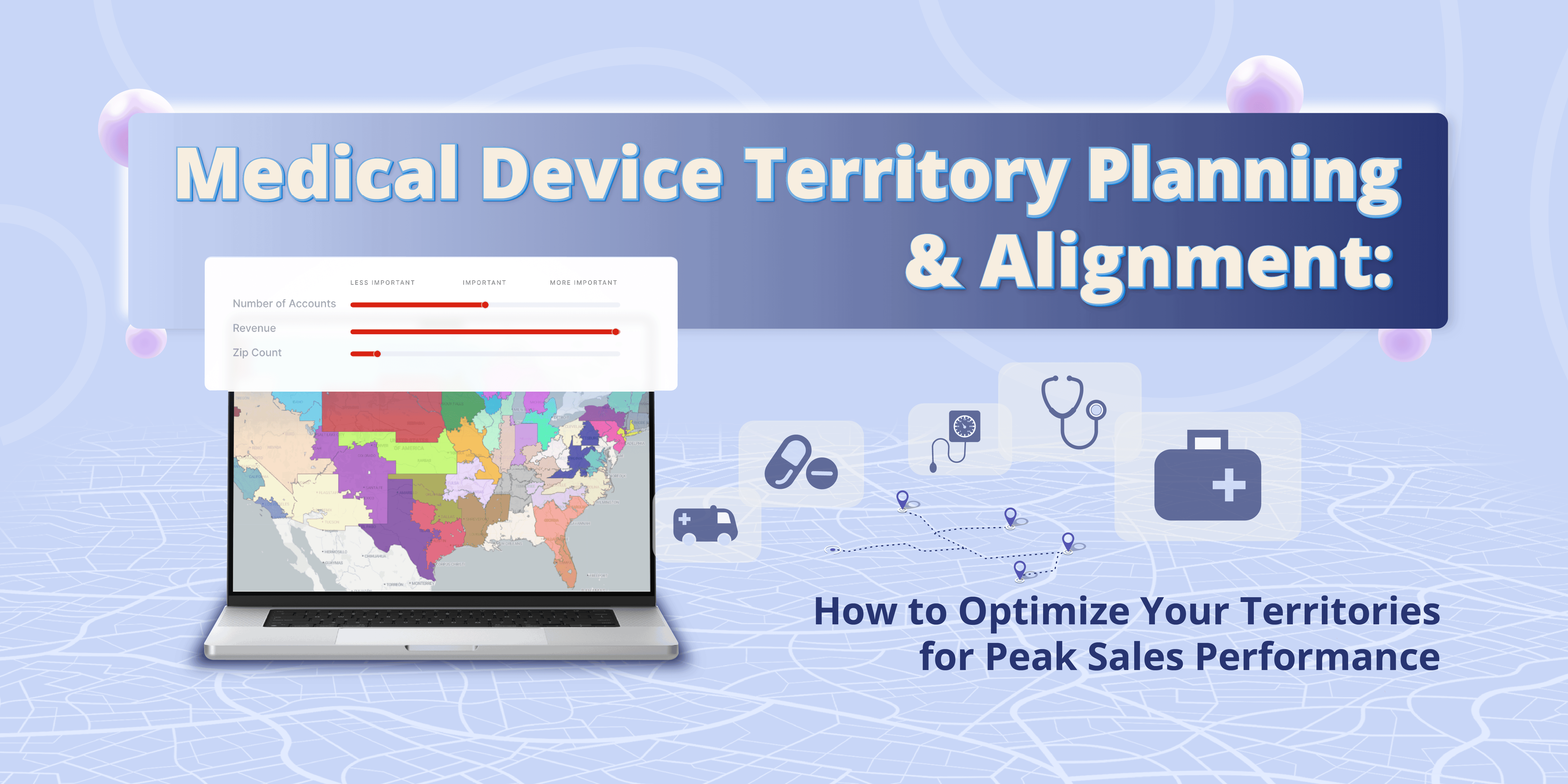
If you’re in medtech sales management, medical device territory planning is the highest-leverage activity you can invest in this quarter.
Don't believe me? Consider what optimized territory alignment consistently delivers for medical device teams:
On the flip side, 2 - 5% of revenue disappears every year due to poor rep-to-territory match and alignment.
Here's the truth: medical device sales reps operate in one of the most complex selling environments in the B2B space. They navigate hospital systems, coordinate with OR schedules, and build long-term relationships with physicians who ultimately determine your success. Effective medical device territory planning reduces friction in all of these areas.
In this article, we break down what medical device territory alignment is, why it matters, how to do it correctly, and why purpose-built territory planning software is no longer optional in the AI-driven sales era.
Medical device territory planning is the strategic process of dividing sales geographies and accounts into specific segments that individual reps are responsible for.
It determines who covers which hospitals, surgery centers, clinics, and physician practices. It also makes sure every valuable account gets the attention it deserves. If you think, "That sounds like the process every sales team goes through," you're right. But also wrong…
Medical device reps must possess deep knowledge - of the products they sell, yes, but also of the inner workings of medical institutions. After all, medical device reps are sometimes asked to attend surgeries and provide technical support on medical devices. (Though it should be noted, said reps are NOT allowed to physically participate in surgeries.)
Plus, a single territory could include a Level I trauma center, three ASCs, and a dozen private practices. And each could have a completely different purchasing process, clinical needs, and decision-making timelines. As such, medical device reps must coordinate with OR schedules, understand surgical procedures well enough to troubleshoot complications, and build relationships with surgeons who depend on their technical expertise.
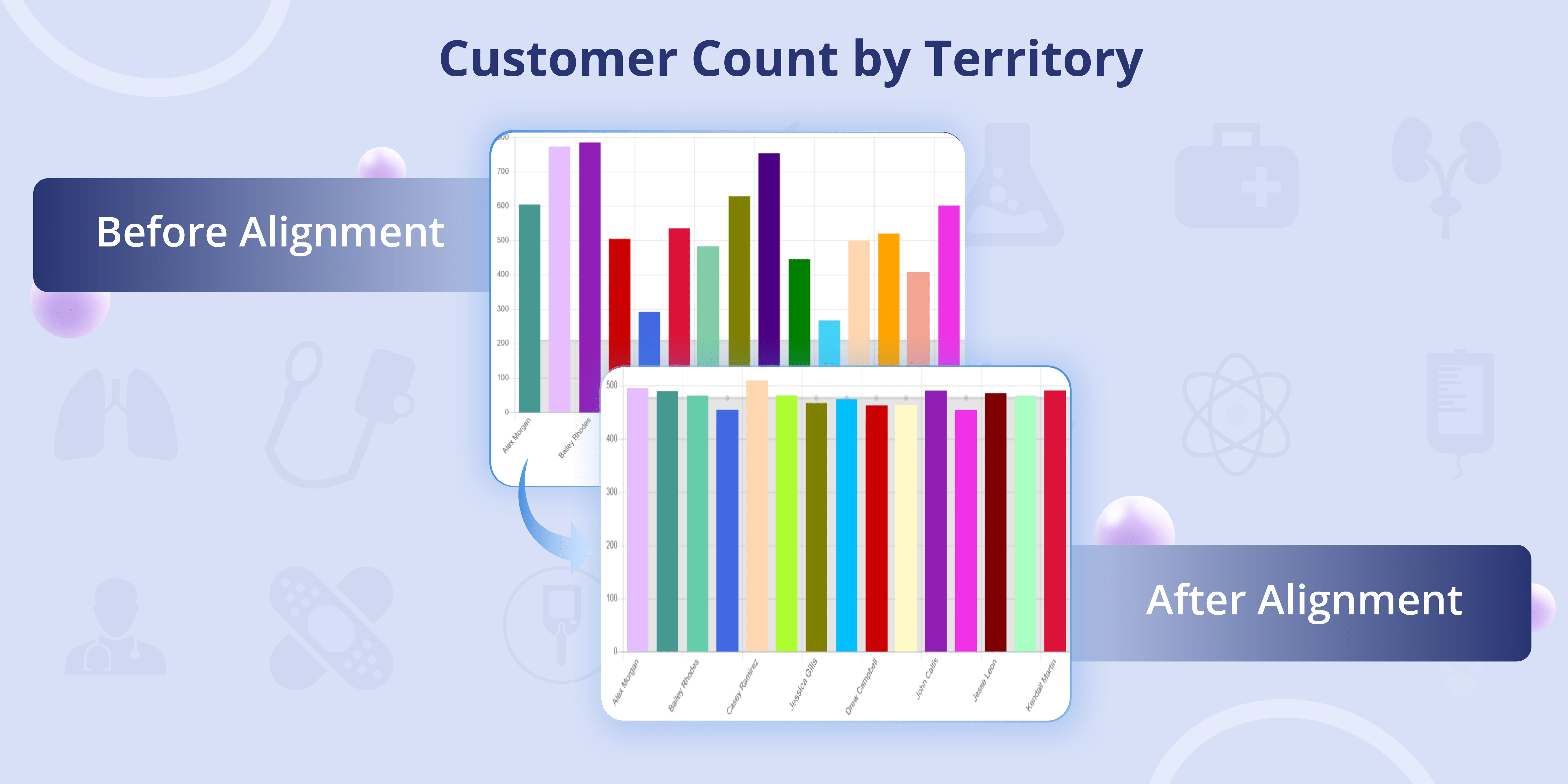
Done well, territory alignment for medical device reps creates clarity, reduces overlap, and ensures high-potential accounts receive consistent coverage from the right reps.
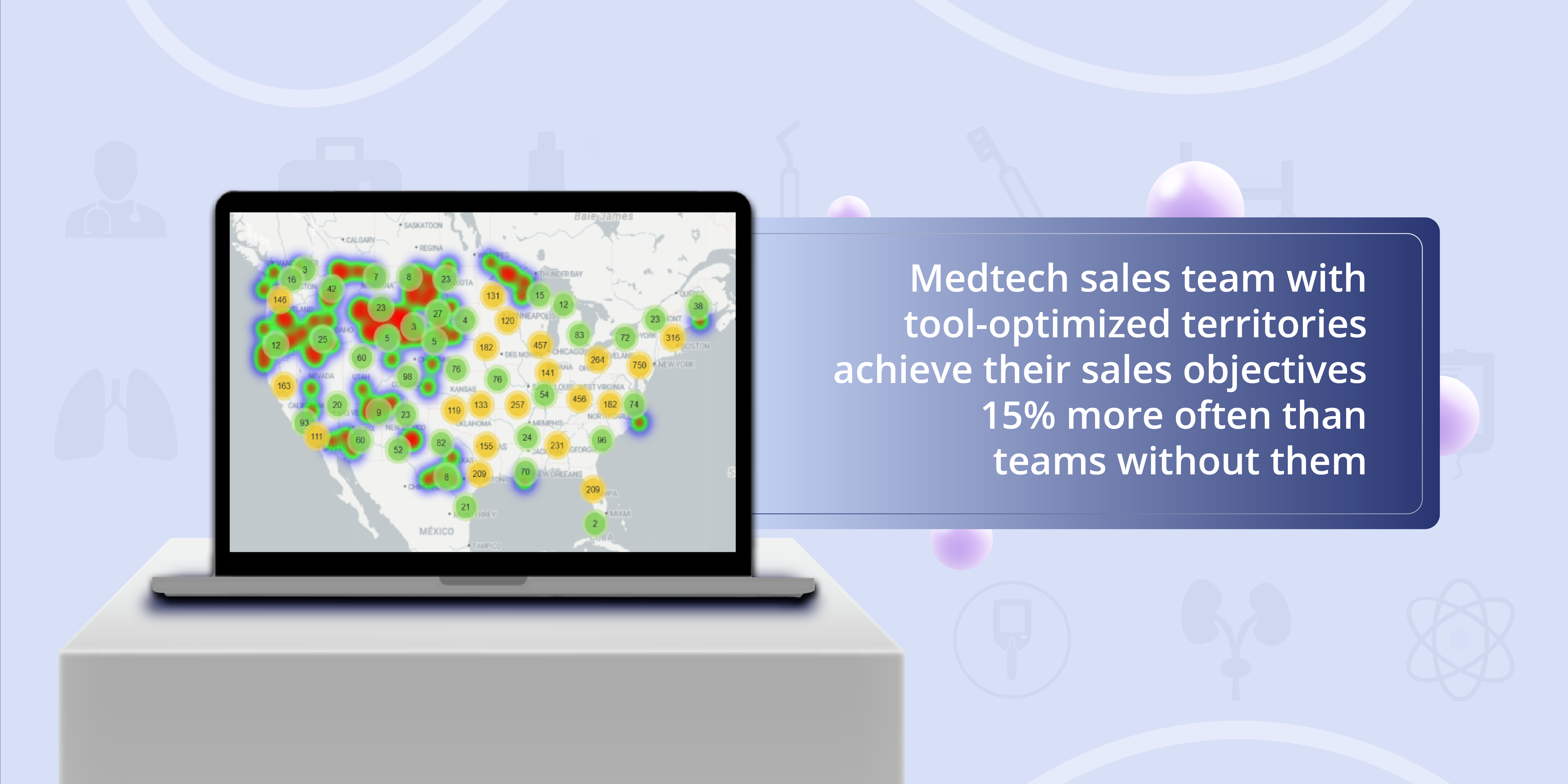
Smart territory alignment is a strategic advantage that touches every part of your sales organization. Here's what changes when you get your territories right:
Medical device reps spend significant time traveling between hospitals, surgery centers, and clinics. Poor territory design creates unnecessary overlap and inefficient routes. The result? Reps spend more time driving than selling, and company revenue plummets.
Optimized territories minimize this waste. In fact, the Alexander Group found that sales organizations with effective sales territories realize 10 - 20% increases in sales productivity.
This makes sense. When reps travel shorter distances, they spend less time on the road. When they spend less time on the road, they can focus on activities that generate revenue. We're talking about building relationships, providing clinical support, and closing deals.
This efficiency translates into fewer costs, less rep burnout, better work-life balance, and more selling time for every rep.
If you base territories on account potential and market data, you'll create predictability in sales outcomes. Think about it: when your reps know who their best leads are, they can focus on selling to them. Doing so will almost certainly lead to better results.
Predictability flows upward too. You can set quotas that reflect real territory potential, forecast revenue with confidence, and design commission structures that align with business objectives. When this happens, everyone knows what to expect and can succeed.
Balanced territories mean you assign the right number of reps - each with the right clinical backgrounds and selling skills - to every geography and customer segment. This prevents two expensive mistakes: overstaffing low-potential areas and under-serving high-value accounts that could drive serious revenue for your organization.
When your alignment reflects true market opportunity, you'll get better ROI on headcount, know where to invest additional resources, and enjoy a sales structure that scales. Instead of reacting to problems, you can expand into high-demand areas with confidence. After all, your data shows you exactly where the growth opportunities are.
Clear-cut territories create comparable metrics across your team, including sales per territory, call activity, conversion rates, coverage density, and growth potential. This comparability makes performance reviews fair and data-driven, not subjective.
More importantly, it gives you the visibility to spot underperforming territories, identify where reps need additional training or clinical support, and reallocate resources before small problems become revenue gaps. When territories are designed with clear parameters, you can make smarter decisions about where to deploy resources for the most impact.
Not all accounts are created equal. A high-volume cardiac catheterization lab or a busy orthopedic surgery center represents more value than a small urgent care clinic.
Proper territory alignment ensures these high-value accounts receive consistent, focused attention. When surgeons and hospital administrators work with the same rep, relationships deepen, trust builds, and customer satisfaction improves. This leads to repeat orders, service contract renewals, upsells opportunities, referrals, and lower churn.
It's like this: After a territory realignment, orthopedic rep Elena was finally able to visit a high-volume surgery center on the regular. The surgical team appreciated having the same rep in every case, and Elena quickly learned their preferences and streamlined their workflow. Within a quarter, the hospital expanded implant usage and renewed its service contract.
Creating fair and balanced medical device territories requires more than gut instinct. Follow this framework to build a territory structure that drives results:
Get crystal clear on what you want to achieve.
For medtech sales teams, goals might include: increasing OR coverage at target facilities. Or improving surgeon engagement rates. Or reducing clinical support response times.
Then again, you might need to balance workload across reps with different experience levels.Or prepare for expansion. Each goal demands a different approach to territory alignment.
Take time to understand your existing process. How do you currently cut territories? What do your reps like about this structure? What complaints do you hear the most?
Maybe your territories are based on outdated account data. Or they've grown organically as reps came and went, creating bizarre boundaries that made sense at the time but now cause coverage gaps and territorial disputes. Maybe high-value accounts are getting ignored because your reps are spread too thin. These are problems that need to be fixed.
Take an honest look at your current territory alignment strategy and write down every pain point. These issues will help guide your redesign.
Your reps aren't interchangeable. One might have deep orthopedic knowledge and strong relationships with spine surgeons. Another might excel at GPO contracts and IDN purchasing processes. A third might be new to the industry but hungry to learn.
List out your reps' individual strengths and weaknesses. Who thrives in competitive metro markets? Who's better suited for relationship-building in smaller communities? Who has the clinical background to support complex cases? Who needs more experience or training?
Wondering how to align medical device territories? It depends on your specific market, products, and sales model. Here are a few common approaches:
Many successful medtech teams use a hybrid approach, combining geography with account characteristics. The key is to choose a structure that matches your go-to-market strategy and the reality of how healthcare purchasing works in your market.
Territory alignment is an ongoing optimization process, not a one-time project. Assess your approach on a monthly basis to catch initial problems. When you're happy with the results, move to quarterly evaluations to spot trends, and annual ones to adjust for market changes.
For each assessment, track metrics that matter: territory-level revenue, account penetration rates, rep activity levels, customer satisfaction scores, and time-to-close. Based on these metrics, which territories underperform? Do certain reps need additional support? Has a competitor moved into a territory and changed the dynamic?
Purpose-built territory tools can help you answer these questions. Spreadsheets can't keep pace with the complexity of medtech territory planning. You need software to model different scenarios, show you real-time territory performance, and help you adjust on the fly.
To illustrate, imagine this scenario: A spine device company realizes their downtown territory is underperforming despite high account potential. Monthly auditing reveals the assigned rep is spending a ton of time at one teaching hospital, while neglecting three high-volume surgery centers. So, the company adjusts the territory boundaries, moves the teaching hospital to a rep with more bandwidth, and sees a 30% bump in revenue the next quarter.
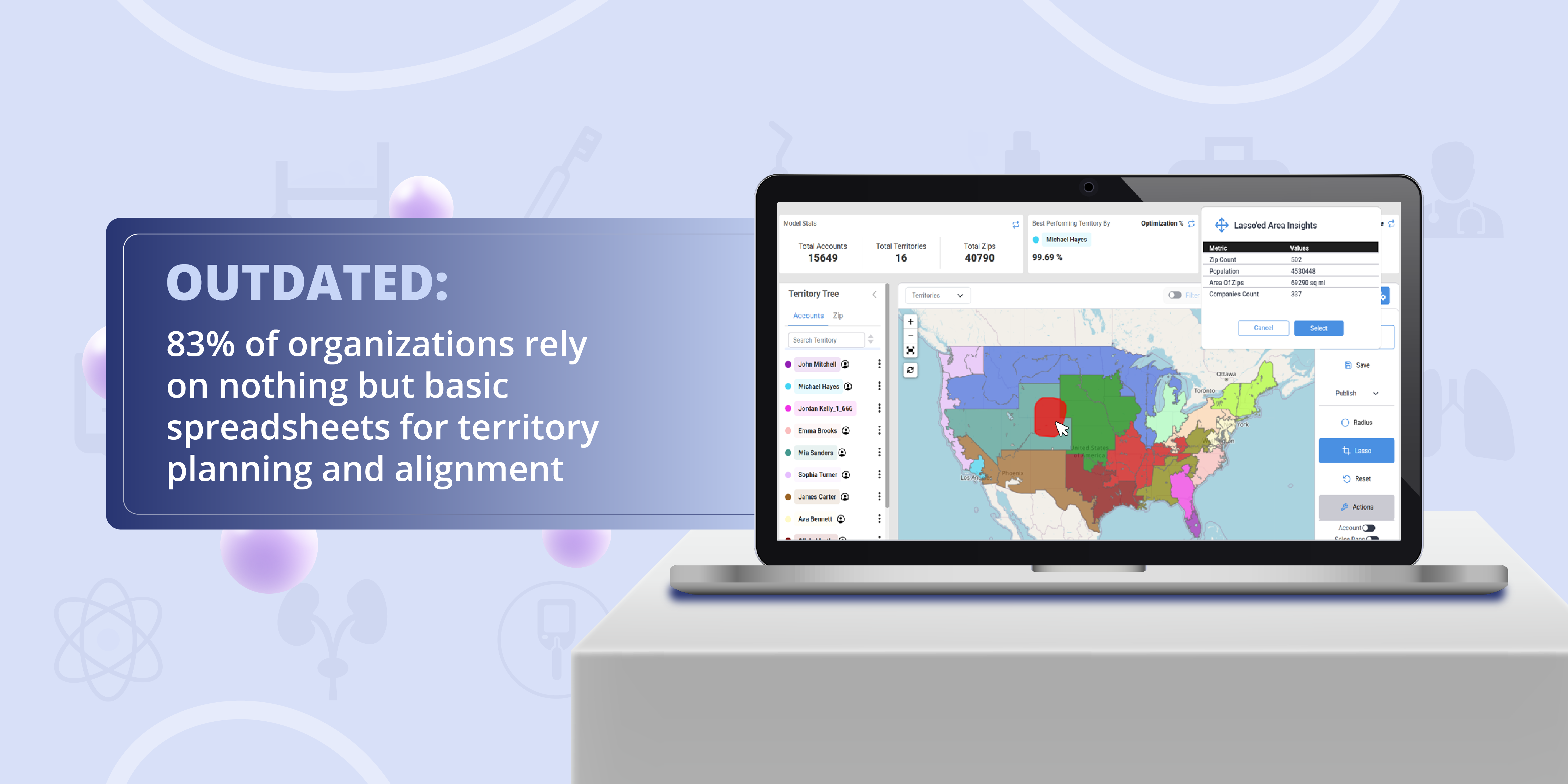
Manual territory planning might have worked when you had five reps covering obvious geographic areas. But as your team grows and your accounts become more complex, you need technology to handle the variables that actually drive medtech sales.
If you're at the beginning your territory alignment journey, follow these steps to evaluate software solutions and choose the right one for team:
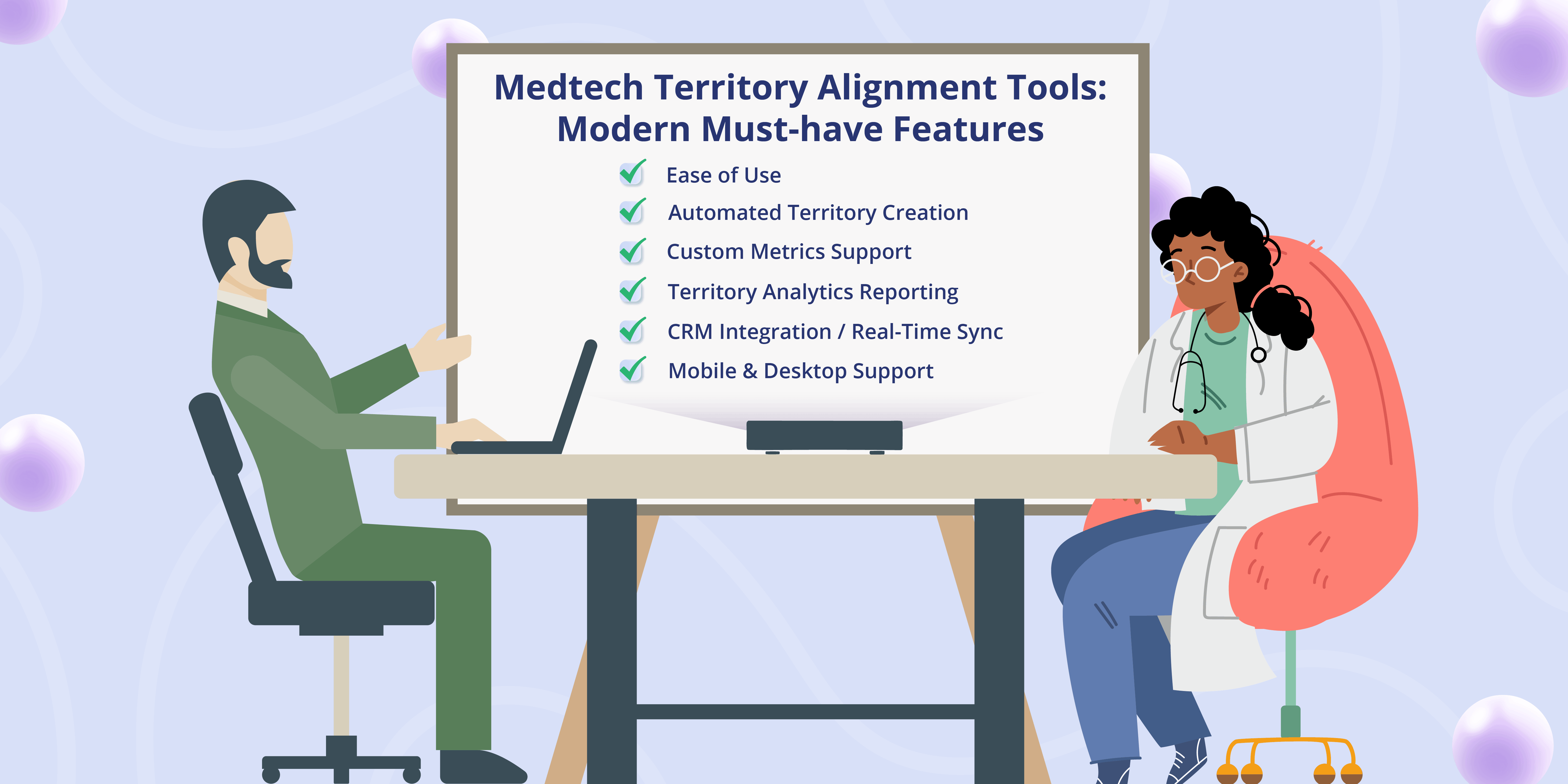
Not every territory planning software can handle the complexity of medtech sales. When evaluating platforms, focus on features that address the unique challenges of hospital and ASC coverage planning, OR scheduling coordination, and long sales cycles.
In addition to these fundamentals, some of the more advanced tools offer relatively useful side features, such as multi-stop route optimization, lead generation, and lead routing. Each of these capabilities can further streamline operations and improve rep productivity.
Lastly, while it makes sense to narrow down your territory alignment tool options based on budget, remember the old adage: You get what you pay for. As highlighted in the previous “benefits” section, when utilized correctly, these types of tools return their cost and then some.There are many options at different price points, but cheaper solutions often lack critical features and reliable support, cutting into ROI.
Looking for the best software for medical device territory planning? Try Badger Align! Our platform lets you autogenerate territories in minutes based on key metrics. You can also test different alignment scenarios to determine the best strategy for your team.
Just as important, Badger is equipped with a real-time territory realignment feature. That way, you can optimize for market changes and improve results without starting from scratch. Plus, it integrates directly with your CRM software, eliminating data entry headaches and ensuring accuracy across your systems. In other words, it has everything your reps need to succeed.
This is especially true if you use Badger Align in conjunction with Badger Routing. Doing so will help your reps traverse their territories in less time, so they can spend more hours with buyers. The results? Teams that use Badger boost site visits by 20% and sales by 3-7%.
Once you take the time to align territories around real market data, account potential, and your reps' abilities, you'll create a foundation for sustainable growth.
Your reps will know where to focus, your high-value accounts will get the attention they deserve, and you'll make smart decisions about where to invest resources.
But it's important to realize that the difference between good and great territory planning often comes down to the right tool at the right time.
If you're still using spreadsheets and static boundaries, you're leaving revenue on the table. Schedule a free demo of Badger Maps to see how our territory planning solution can help you optimize coverage, increase productivity, and drive growth for your medical device sales team.
Badger Maps is a routing & mapping app that automates data collection and uplevels field team performance. From planning your day to managing your territories, Badger optimizes every aspect of the field sales process.
Looking for our logo?
Grab a Zip packed with our logo in PNG and EPS formats.


