News: Now offering SSO.
Learn more
News: Now offering SSO.
Learn moreStop me if you've heard this one before… your best rep's pitch meeting went over, so now they’re late to their next meeting and stuck in traffic, watching a $50,000 deal slip away.
Why? They planned their route the way they navigate to brunch - by casually using their phone’s default routing app.
Here's the uncomfortable truth: most field sales teams bleed money via bad routing.
How? They treat optimized routes with multiple stops like an inconsequential option, not a competitive advantage.
Sales route optimization separates quota-crushers from quota-missers. When they nail their routing, your reps will fit more meetings into each day, show up on time, and close more deals. When they don't, they'll burn gas, waste valuable hours, and blame "bad territories."
In this article, I explain what optimizing sales routes is, why it matters more than ever, and how to do it effectively. Let’s dig in so you can get started putting your reps in the best position to succeed!
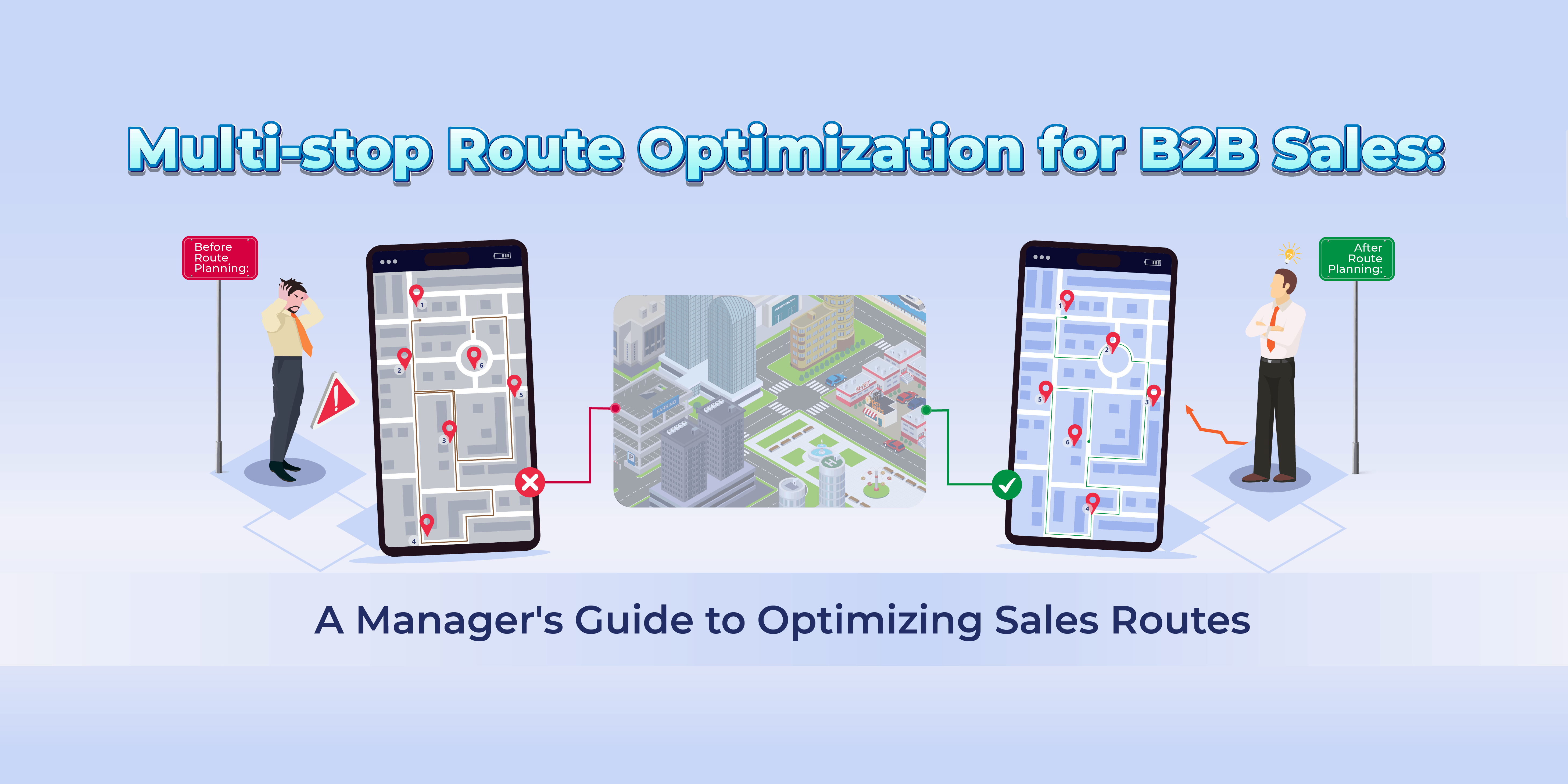
Ever heard of the traveling salesman problem? Route optimization solves this complicated puzzle, designing the most effective path between locations.
Notice I said the "most effective path" and not the "shortest path." For field sales teams, route optimization is about visiting multiple customers in a way that increases revenue potential.
What does this look like in real life? While basic routing tells reps how to get from point A to point B, sales route optimization considers visit value, appointment windows, customer priorities, and realistic travel times to build a full-fledged travel plan.
Put simply, route optimization in sales doesn't just answer questions like "How do I get there?" It accounts for multiple factors, then tells you where to go first, second, and third for max impact.
This is what field sales reps need. After all, you don't pay them to visit one customer per day. You pay them to juggle seven, eight, or more stops across a territory, each with different priority levels, time constraints, and money-making potential.
Bottom line: This multi-stop route planning complexity makes sales route optimization different from consumer navigation.
Jeremy is a field sales rep for Pure Aqua Distributors (PAD), a beverages company based in San Diego, CA. Jeremy walks into the office, fires up his computer, and plans his day.
He has to visit a high-value prospect in downtown, as well as six or seven lower-priority leads scattered throughout the city, He also has to check in with a key account in Carlsbad, which is about 40 miles north, but he can only visit between 2-4pm, when his contact is available.
Jeremy tries to brainstorm optimized routes with multiple stops for peak efficiency. Eventually, he gets frustrated and just drives to the nearest customer. I feel your pain, Jeremy!
Multi-stop sales routes are hard to plan because the shortest route isn't always the smartest route. You have to balance distance, value, and availability. In other words, driving an extra fifteen minutes might make sense if it gets you in front of the right prospect at the right time. But how do you know when to take these chances? Don't worry, we'll get to that.
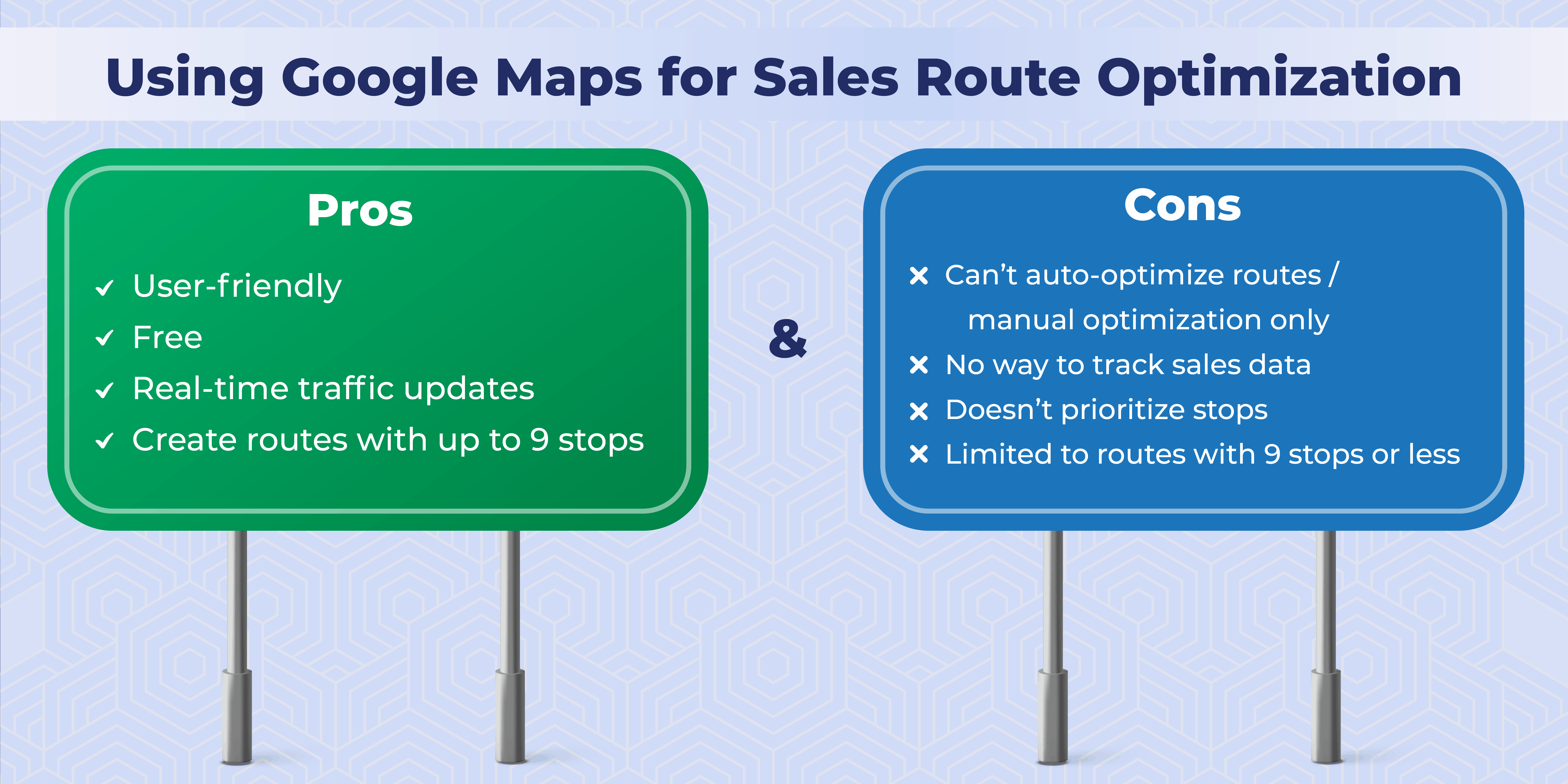
Route optimization and Google Maps are NOT compatible, especially if your reps have 4+ stops in a day. Same with Apple Maps, Waze, and even ol’ MapQuest. Sure, while these apps may work in a pinch to help plan multi-stop sales routes, efficiency is the name of the game when it comes to sales, and these navigators definitely aren’t efficient!
Why? Because road navigation and sales route optimization are two different things.
Google Maps shows you how to get from Point A to Point B. But it can't help you prioritize stops based on account value. Or factor in customer schedules. Or understand that it's okay to spend more time in the car if it helps you meet with the top prospect in your CRM at the ideal time.
Bottom line: When it comes to multi-stop route planning for sales, Google Maps falls short. You need a better way to increase sales route efficiency. Let's talk about that…
Smart field teams plan sequences, not directions. They also know how to balance visit value and travel time, and they're committed to re-planning throughout the day if/when needed.
The difference between an average day and a great day in the field often comes down to visit order. Reps need to identify the best account to hit first, the accounts that anchor their day because of firm appointment times, and the accounts that can float - i.e. be reached at any time.
To create optimized routes with multiple stops, start by understanding the full picture: account priorities, geographic clusters, time windows, and realistic drive times between locations.
This isn't something you can eyeball on a map. You need data. Once you have it, your reps can plan multiple sequences that they'll go through during the day.
Skip the second-hand reports and go to the source of the data yourself - learn the value of field sales ride-alongs from sales guru Alice Kemper!
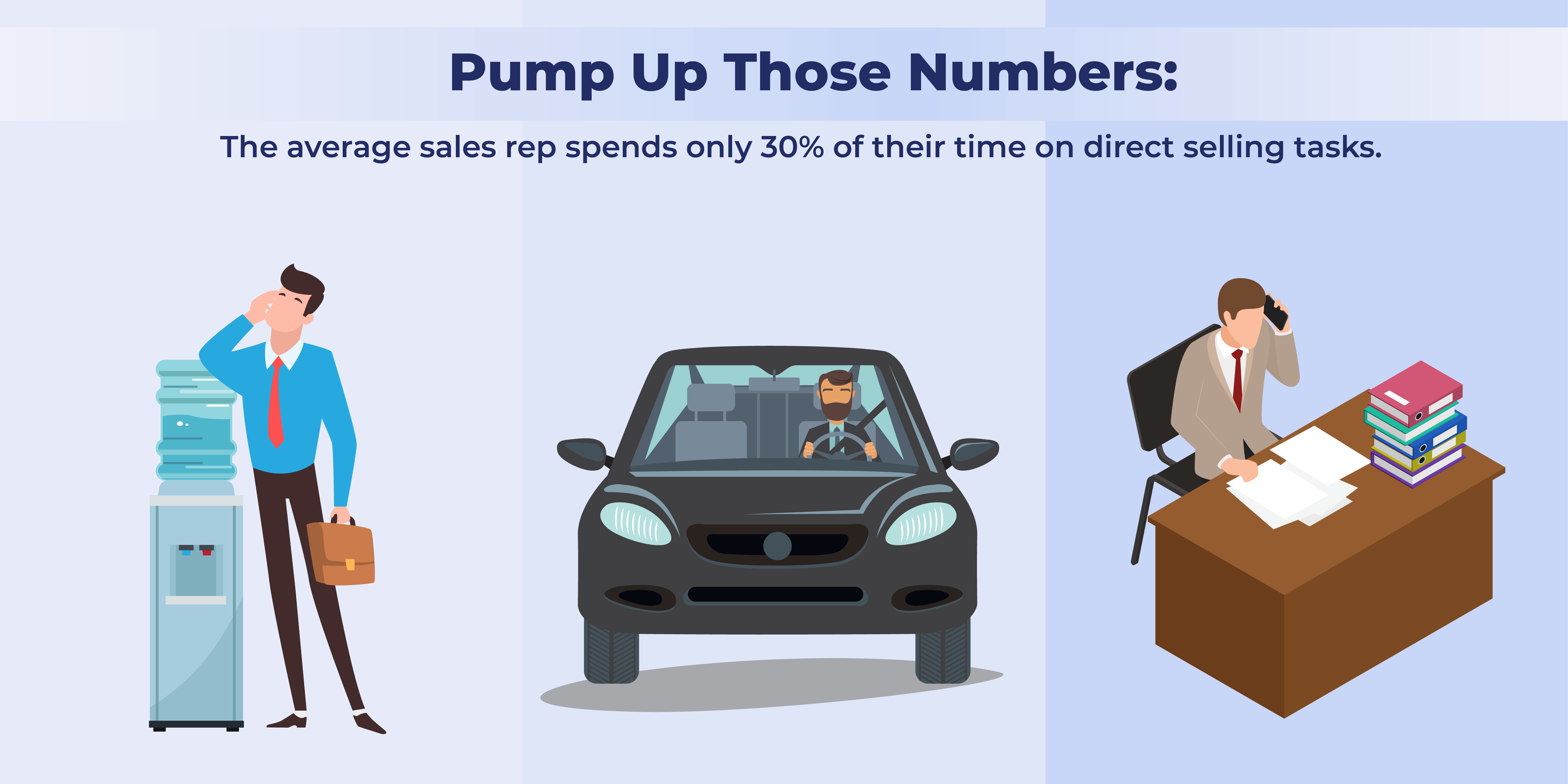
The average sales rep only spends 30% of their time on direct selling tasks. The rest disappears into planning, traveling between prospects, and dreaded admin work.
Your reps only have a few hours to meet with customers each week. They need to maximize this time by building efficient sales routes, which they can do by balancing visit value (how much the account could be worth) and travel time (how long it takes to reach said account.)
What does this look like in real life? Sometimes, high-performing reps will skip specific accounts because they're low-value and add 30+ minutes to a route - even if they won't be out that way again for a few weeks. Other times, said reps will happily add an hour worth of driving to their routes because it will enable them to meet a high-value prospect at the right time.
Reducing drive time for sales reps is important, but visit value must be accounted for. Top reps balance both to hit quota. Your reps should do the same.
Planning efficient sales routes is NOT a one-time task. Meetings run long. Prospects cancel their appointments. New opportunities pop up mid-route and can't be ignored.
Because of this, your reps need to commit to optimizing multi-stop routes throughout the day. If they stick to a rigid schedule made at 8am - before reality sets in - they won't close many deals.
Reps who can re-plan at any time are much more likely to hit quota than those who can't.
Make sure you’re using the right tool for the job: We did the legwork for you and assessed the top sales route optimizers by industry.
As discussed, sequencing sales visits is key to success in field sales. But how do you do it? Let's talk about why visit order matters, how to prioritize stops, and time windows.
Visit order is important for two reasons: rep psychology and practical outcomes.
Anna sells solar panels for Sunny Days Solar Co. in East Texas. She knows that when she gets to work the next day she has to cold call a list of prospects and visit an existing account. Anna doesn't enjoy cold calling, but she always leaves the existing account's office with a smile.
Which task should she complete first? A rep's emotional state matters. They can't do their best work if they're "down in the dumps" all day. So, if possible, Anna should visit the existing account first. She'll enjoy the experience, and can then tackle the cold calls in a good mood.
Of course, rep psychology isn't the only factor. Visit sequencing affects practical outcomes. You shouldn't visit six prospects before your most important meeting if you'll be exhausted and off your game. Neither should you spend the morning on low-value maintenance visits, then cram your best prospects into tight windows that don't leave wiggle room between meetings.
Now that we've covered visit order, let's talk about visit prioritization for field sales.
Not every customer deserves your undivided attention. A prospect that represents $50K in potential annual revenue should be treated differently than a routine check-in worth $2K.
I don't want your reps to ignore smaller accounts or show them any level of disrespect. Instead, I want them to be intentional about when they visit these accounts and the amount of energy they expend during each encounter. These accounts should act as "buffer stops" between major appointments or "fill gaps" when higher-priority meetings fall through.
Make sure your reps sequence sales visits in a way that prioritizes high-value prospects.
There's one more piece of the puzzle to factor in: customer constraints.
What if a top prospect is only available between 10-11am on Tuesdays? Or your best customer requires morning visits because their warehouse closes at noon? Then there are those good-not-great prospects who can only meet after 3pm, but are all located in the same area.
Time windows have to be factored into your sales route optimization efforts. My suggestion? Use them as anchor points that your reps build the rest of their days around.
In the end, the most efficient sequence on paper might not be possible due to real-world scheduling realities. Fortunately, by considering visit order, stop value, and customer availability together, your reps can build routes that turn time into revenue.
At this point, we know that "route planning" and "directions" are different. Now, it's time to go deeper and distinguish route planning optimization from simple route planning.
What's the difference? Simple route planning is the starting point. You look at your territory, identify the accounts you want/need to visit, and sketch a path to make it happen. This approach is static, often done once at the beginning of the day, week, or month.
Route planning optimization is an ongoing practice that forces reps to continuously refine their approach based on real-time data. What actually happens when your reps are in the field? Did a promising opportunity peter out? Did a low quality lead become a higher value target? Maybe the city just began work on a key road along your route and traffic is a nightmare.
Static routing assumes the best case scenario in every situation, while adaptive routing accounts for new information and schedule changes. This can lead to serious productivity gains and can also lower gas costs by as much as 20%.

Does anything go according to plan in sales? Eh, sometimes.
More often than not though, the meeting you thought would take 30 minutes goes for 60+. A prospect who was "just browsing" asks dozens of questions. The client meeting you scheduled weeks ago is canceled at the last second.
Each of these situations requires re-planning. Here's how to do it:
Your morning route looks great on paper at 7am, but everything changes by noon. Dynamic route planning acknowledges this reality and builds flexibility into your system.
Delays: Your reps can fall behind for a variety of reasons. Poor planning, bad traffic, longer-than-expected meetings - the list goes on. As with add-ons, train your reps to assess their next step and make the proper decision. Whatever they decide, make sure they update all interested parties so no one is expecting them to arrive on time.
Static plans assume perfect conditions: no traffic, no delays, no surprises.
They also assume every account interaction takes exactly the amount of time your reps expect them to. Anyone who's spent a day in field sales knows these are false assumptions.
The value of route optimization isn't in the initial plan. It's in the ability to adjust the plan as needed. Because reducing drive time for sales reps isn't a one-shot deal. It's something your team will work on every day so they can reach peak productivity as often as possible.
Sales route optimization and sales mapping are connected but distinct disciplines.
Sales mapping determines where your opportunities are. It helps visualize and manage a territory, shows where accounts cluster, and helps reps understand the geographic distribution of their pipelines.
Sales route optimization determines the order in which reps visit the mapped locations - preferably in an efficient way. After all, you can't optimize a route without knowing where you're going, and you can't effectively use a map without a plan for moving through it.
Meet Ryan, a medical device sales rep in Richmond, VA. Thanks to modern technology and a heaping pile of real-time data, Ryan has mastered the art of sales route optimization.
But what if Ryan had to plan routes without knowing which accounts were hot prospects and which were cold leads? Or which customers have time-sensitive needs and which have flexible schedules? His route would probably be geometrically perfect, but strategically useless.
To plan effective routes, Ryan needs context which he can get from his company's CRM, industry benchmarks, his previous experiences, etc. With it, he can turn driving routes into sales strategies that generate revenue for his medical device manufacturing organization.
Your sales reps are the same. When optimizing sales routes, your reps need more than addresses. They need real-world intelligence to understand why stops matter.
Do you use Salesforce or Hubspot as your CRM? Check out the Salesforce guide or Hubspot guide to sales mapping software to make sure you’re maximizing your CRM potential!
Sales routing problems aren't always about routing. Sometimes, they're just symptoms of a deeper territory issue. Here are a few tips to help you through these situations:
If your reps drive multiple hours a day to reach prospects - even after they fully optimize the sequence of their stops - the issue is about territory design, not routing.
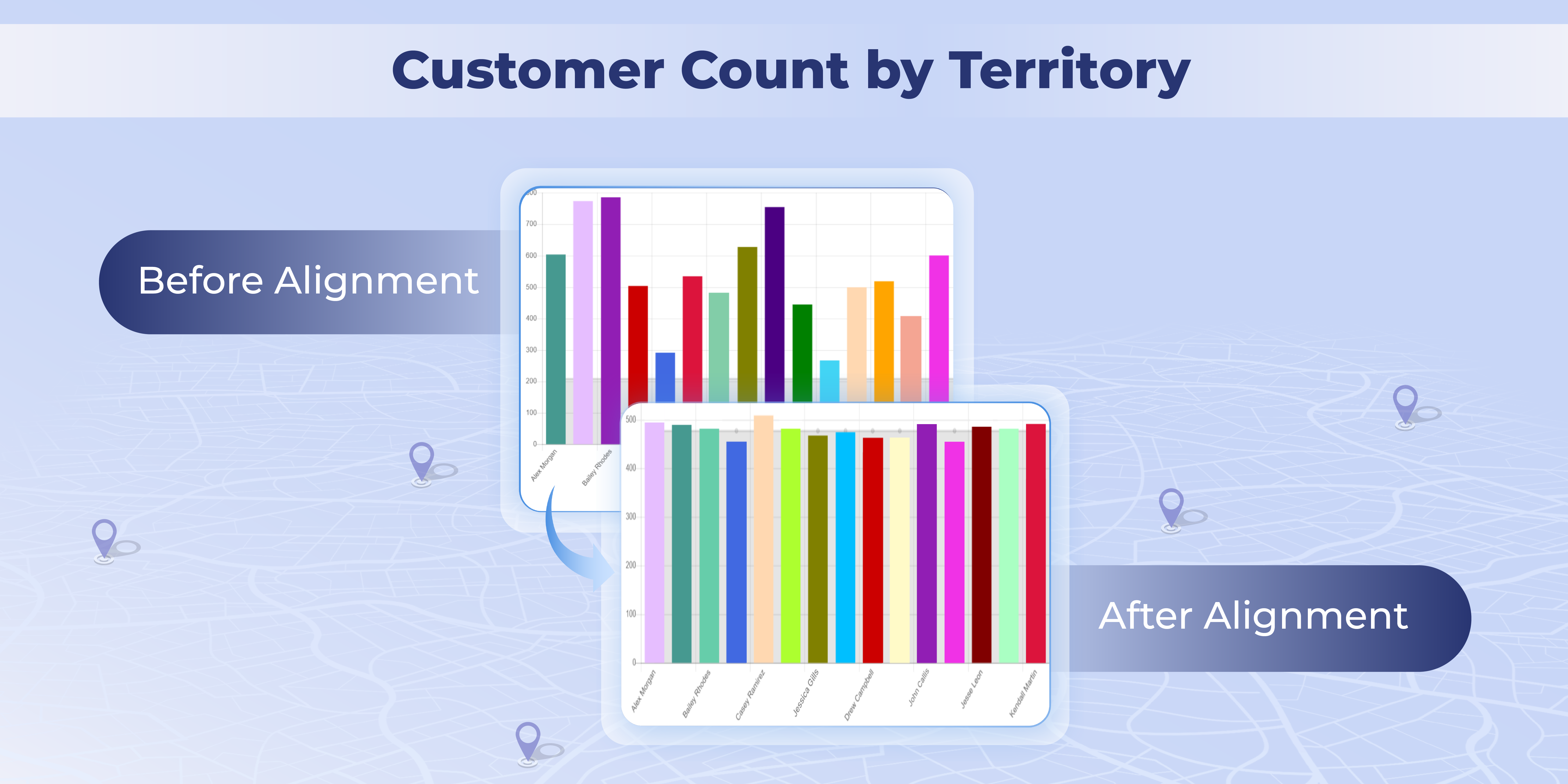
When a rep's accounts are scattered across a massive geographic area with no natural clustering, route planning fixes won't solve the fundamental inefficiency. You need to go back to the drawing board and recut territories so that your reps can properly cover them.
Let's dig deeper into this territory planning problem.
Victor's Vacuums employs a small team of field sales reps. Unfortunately, the team's sales manager hasn't aligned territories in years. This has led to serious problems.
One rep is asked to cover 200 square miles with sparse account density. As such, the rep spends half their week in the car. Another rep is asked to cover 50 square miles, but it's packed with prospects and they struggle to meet with everyone. Better routing will fix it all, right? Wrong.
While sales routing might eke out an extra hour or two of efficiency, the real problem is territory design. The first rep's territory is too large. The second rep's territory is too dense.
At the end of the day, sales route efficiency depends on well-built territories. Before you invest heavily in route optimization, make sure your territories are balanced and work for you.
When assessing routing capabilities for your field team, focus on features that actually solve your problems.
Here are the top eight that I suggest you focus on:
Learning about sales route optimization strategies and actually implementing them are two different things. Avoid these common mistakes during the implementation process:
Just because the algorithm says it's the shortest route, doesn't mean it's the best route.
For instance, the shortest route might lead your rep to a top prospect at 9am, but said prospect can only meet between 11am and 12pm. This is not an example of sales route efficiency.
Obviously, it's better to increase windshield time and attend meetings at appointed times than it is to decrease windshield time and wait hours in parking lots to meet with prospects.
Treating every stop equally is another common mistake in multi-stop route planning.
Why should a $500 opportunity get the same consideration as a $50,000 opportunity? It shouldn't. The latter opportunity is worth 10x more to the sales rep.
Many routing systems fail because they optimize for distance and time but ignore the business value of each interaction. Never rush to make less money.
Do you execute every plan in the exact way you planned it? Hopefully not…
Things almost never go according to plan in field sales. Some of your meetings will run long. Some of your appointments will get canceled. So, you'll need to adjust routes on the fly.
You should also treat every route as a learning opportunity. What worked? What didn't? Where did your reps waste time? Where should they have dug in and logged more hours? Use this information to plan better, more efficient routes in the future.
So what if your rep drove 20% less last month? If it didn't lead to more revenue it doesn't matter. Sales route efficiency is only valuable if it creates better business outcomes.
Sometimes the "inefficient" route that includes an extra stop at a surprise hot lead is the most effective choice. Train them to chase effectiveness more than efficiency.
Route optimization isn't a "set it and forget it" strategy.
The best field sales teams treat routing as an ongoing habit. They review what worked each week, identify activities that drain time, and refine their approach for more success.
Remember, the first routes you optimize won't be perfect, but they'll get better as your team learns. Measure what matters: drive time, customer interactions, territory coverage, and revenue per rep. Then work to improve these metrics over time and achieve better results.
Speaking of better results, are you ready to see how route optimization technology can transform your field team's efficiency? Schedule a free demo of Badger Maps today!
Badger Maps is a routing & mapping app that automates data collection and uplevels field team performance. From planning your day to managing your territories, Badger optimizes every aspect of the field sales process.
Looking for our logo?
Grab a Zip packed with our logo in PNG and EPS formats.


