News: Now offering SSO.
Learn more
News: Now offering SSO.
Learn more
What happens when globally renowned keynote speaker and efficiency expert Juliet Funt sits down with Outside Sales Talk host Steve Benson to talk virtual selling?
You get a masterclass in the stuff most sales trainers never think to cover - the production, the presence, the psychology, and the practical tricks that separate "good enough" from genuinely great on camera.
Juliet Funt didn't just share theory; she gave Steve - and by extension, every outside salesperson tuning in - a concrete, actionable playbook for showing up better in every virtual room they enter, and we've distilled the best of it right here.
Want to take a look at the full interview for even more Juliet Funt sales gems? Listen to the full Outside Sales Talk episode Nailing Your Virtual Presentations with Juliet Funt or find it on Apple Podcast, Spotify, Pandora, and YouTube.
"What happened during the pandemic was we all got shoved into this medium, and everyone settled at this 'good enough' level. We started good enough, froze there, and now the whole world lives at good enough. That's a problem because it doesn't allow salespeople to differentiate or play their best game for their biggest clients."
Juliet's opening salvo is a wake-up call: most sales professionals are operating at a level of virtual competence they established in a crisis - and never improved from. The good news is that the bar is low, which means the upside for anyone willing to put in the work is enormous.
Why This Works: In a world where every competitor is also stuck at "good enough," the salesperson who invests in genuine virtual mastery has an asymmetric advantage. You're not just getting better at Zoom - you're differentiating yourself in the moments that matter most.

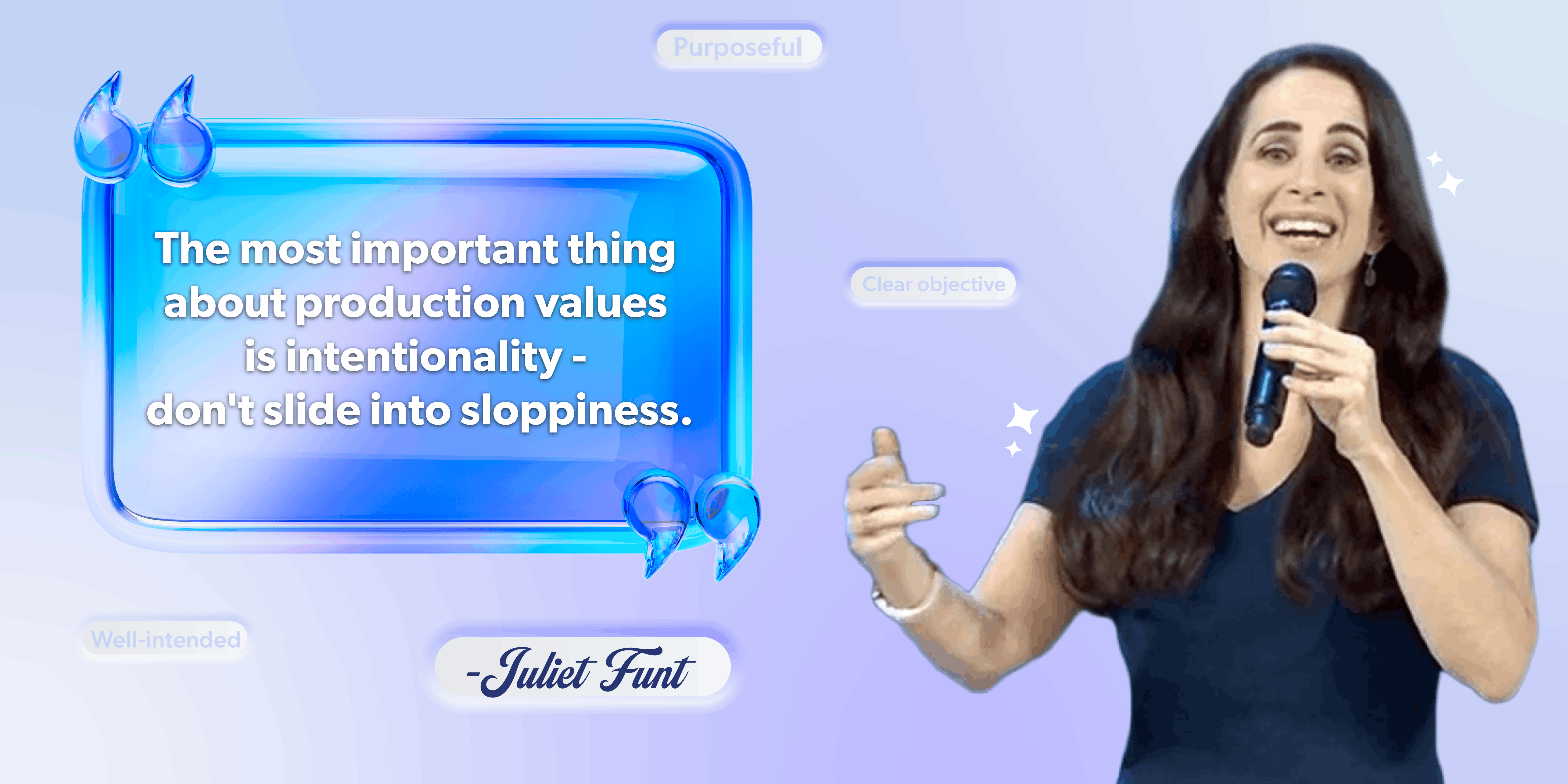
"The most important thing about production values is intentionality - don't slide into sloppiness. The pandemic birthed this beautiful authenticity where we were thrust into each other's lives, but a lot of sales professionals confused that intimacy with sloppiness."
Before you say a single word in a virtual sales call, your camera angle, lighting, audio, and background have already made an impression. Juliet's framework here is simple: every production choice should be deliberate, not accidental.
Why This Works: Buyers make subconscious status assessments in the first few seconds of a call. A clean, well-lit, well-framed setup doesn't just look professional - it signals that you're someone who pays attention to details, which is exactly the impression you want to make before your sales pitch even begins.
Production quality is just one piece of showing up powerfully in a sales conversation. For a deeper look at how nonverbal signals - even on camera - affect how buyers perceive you, check out Mark Bowden’s Sales Success Through Body Language & Nonverbal Communication.
"If we don't talk about levels, people think 'I'll get good at virtual' and put the same effort into every conversation. It's exhausting - this is an exhausting medium."
Zoom fatigue is real, and Juliet has a practical antidote: a three-tier framework that helps salespeople calibrate exactly how much energy and production effort each type of virtual interaction actually deserves.
Why This Works: Field salespeople who've spent years on the road already understand energy management intuitively - you don't give a formal pitch to someone you're just checking in with. Juliet's ABC framework simply applies that same instinct to the virtual world, helping you manage your sales productivity without running on empty.
"I walk into the room and start the 360 spin - looking for the best options in the room. Find your best spot, then start stacking."
For outside salespeople, the challenge isn't just mastering virtual calls at a home office - it's pulling off a credible, professional virtual meeting from a hotel room in Tulsa at 7 a.m. Juliet has done this enough times to turn it into a repeatable system.
Why This Works: Field sales reps spend their lives adapting to environments they don't control. Juliet's road framework turns that adaptability into a system - so that no matter where you are, you walk into a virtual meeting looking and sounding like someone worth doing business with.
PRO RESOURCE: Staying sharp and productive while constantly on the move is one of the defining challenges of field sales. See how Jeb Blount's 8 Time Management Secrets can help you build the habits that keep you at your best, wherever you are.
"One of the biggest mistakes people make entering the virtual room is skipping the handshake. They put slides up while the person's in the waiting room. When they enter, they meet you as a tiny thumbnail with a big slide - no moment to say hi, look at the camera, let them look at you, shake hands virtually."
The opening moments of a virtual sales call set the tone for everything that follows - and most salespeople are blowing them. Juliet offers a handful of high-impact, easy-to-implement fixes that make an immediate difference.
Why This Works: Attention is scarce in virtual meetings - your prospect may have just come from five other calls and has three browser tabs open. A strong opening, natural eye movement, and crisp vocal emphasis are the tools that break through passive "receiving mode" and create the kind of effective sales communication that actually sticks.
First impressions in sales go beyond the virtual room. For a deep dive into how the best closers use story, tone, and structure to captivate from the first sentence, check out Paul Smith’s Guide to Selling With a Story.
As Steve shares with Juliet during the interview, one of the most persistent frustrations of virtual communication isn't the technology - it's the silence.
On the very morning of their conversation, Steve had given a company-wide talk to 75 Badger Maps employees across multiple continents - and experienced firsthand what Juliet had been describing: "It's hard with groups, speaking into a void of mutes: 'Is this on? Are you with me?' You get smiles in person - here, you just get nothing. Terrible."
The exchange that follows is one of the most honest moments in the interview. Steve admits he craves the feedback loop - the laugh, the nod, the leaning forward - that tells him something is landing. Juliet's response is blunt and clarifying: in this medium, you have to let go of that need.
Why This Works: The desire for real-time validation is deeply human - and deeply counterproductive in virtual sales. The sooner a salesperson accepts that the feedback they're used to simply won't come through the screen, the sooner they can redirect that energy into preparation, presence, and performance.
Juliet Funt's framework for virtual selling is built on one core idea: intentionality beats improvisation, every time.
So start today: pick one of Juliet Funt’s sales presentation tips, and plug it in to your process! Whether it's your camera angle, your energy level, your slide density, or the way you open a call, every element of a virtual presentation either helps or hurts your ability to connect - and very little of it happens by accident. Know your ABC level before every call, do the 360 spin in every hotel room, give the virtual handshake every single time, and stop waiting for the audience feedback that isn't coming.
Bottom line: The salespeople who master the virtual sales medium will have a meaningful edge over the colleagues still living at "good enough."

Badger Maps is a routing & mapping app that automates data collection and uplevels field team performance. From planning your day to managing your territories, Badger optimizes every aspect of the field sales process.
Looking for our logo?
Grab a Zip packed with our logo in PNG and EPS formats.


