News: Now offering SSO.
Learn more
News: Now offering SSO.
Learn more
More often than not, a well-told story in a sales pitch can make the difference between a closed lost vs a closed won.
How?
Storytelling drives decisions. If you’ve ever wondered why some sales pitches land flat while others land perfectly and stick in a buyer’s mind, storytelling might be the missing piece - especially in competitive field sales where logic alone rarely closes deals.
Paul Smith, a former Procter & Gamble executive turned bestselling author of Sell With A Story, Lead With A Story, and The 10 Great Stories Leaders Tell, is truly one of the world’s leading experts on organizational storytelling. He joined host Steve Benson on Outside Sales Talk to reveal how stories outperform traditional pitches, in one of our greatest episodes yet. We’ve distilled the top Paul Smith sales insights into actionable takeaways you can start using today to make your pitches and sales process interactions more memorable, emotional, and persuasive.
Want the full discussion? Listen to the full Outside Sales Talk episode Selling With A Story with Paul Smith or find it on Apple Podcast, Spotify, Pandora, and YouTube.
"It turns out humans don't make the rational, logical decisions that we'd like to think they do," Paul explains. "Many, if not most, of our decisions are actually made in a subconscious, emotional processing part of the brain. And then we justify those decisions a few nanoseconds later in a more rational thinking, conscious thinking part of the brain."
This is the fundamental reason why storytelling works so powerfully in sales - it's the only communication tool that reaches both decision-making centers simultaneously.
Why This Works: By engaging both the emotional decision-making center and the rational justification center of the brain, stories create a complete persuasion pathway. Your buyers feel compelled to act (emotional brain) and have the logical reasons they need to defend their decision (rational brain). This dual-engagement is what transforms interest into action.
People forget 50% of what they learn within the first 24 hours and remember less than 10% of that a week later. Learn why this concept especially matters in sales with Lee Salz and his differentiation techniques.
"There are dozens of stories you need to be able to tell over the course of a sales process," Paul emphasizes.
Paul shares that effective sales communication requires different narrative approaches as prospects move through their buying journey - from initial contact through closing and beyond.
Why This Works: Each stage of the sales process requires different psychological objectives - awareness, trust, urgency, validation. Using the wrong story at the wrong time is like using a hammer when you need a screwdriver. Strategic story placement ensures you're addressing the exact concern or question your prospect has at each moment in their decision-making journey.
"An objection isn't a fact, it's a story - and it's a bad story," Paul reveals. "They're thinking if I buy what you're selling, it's not going to work right. It's going to be too expensive. I'm going to blow my budget. My boss is going to yell at me. I'm going to get a bad performance review. I'm going to get fired."
Understanding that objections are narrative constructs changes everything about how you handle them.
Why This Works: Objections live in the emotional, story-making part of the brain - the same place where purchasing decisions are made. Logical rebuttals activate the wrong part of the brain entirely. Story-based objection handling meets buyers where their concerns actually exist and provides the emotional proof they need to move forward with confidence.
"This is when the buyer says, you know what? I love that. We need that. I can afford that. But now is not the right time. Come back in six months," Paul describes. "That's like the worst thing in the world. Basically, I did my job great as a salesperson. And you're still telling me to come back later."
The dreaded "soft no" requires a specific narrative technique to overcome.
Why This Works: When everything else is working - they like your solution, see the value, and can afford it - the only barrier is psychological inertia. Stories about others who delayed and suffered real consequences create emotional aversion to waiting that math alone cannot generate. The fear of becoming the protagonist in a similar cautionary tale is often the final push needed to close the deal.
"I asked buyers, what could salespeople do to immediately earn credibility with you?" Paul shares. "Almost all of them told me the same two things. One is ‘tell me when you made a mistake before I find out from somebody else.’ And the second one was ‘tell me when you can't help me.’"
Counterintuitively, stories about when you weren't the hero build more trust than stories about your victories.
Why This Works: Every salesperson claims to be trustworthy and customer-focused - it's meaningless without proof. Stories demonstrating past trustworthy behavior provide that proof in a way that promises cannot. When you show through narrative that you've sacrificed potential sales to do right by customers, you separate yourself from 99% of salespeople and create psychological safety that enables larger commitments.
Want more tried and true tactics to demonstrate your credibility and build trust? Look no further than Chris Voss’s FBI secrets playbook - applied to sales!
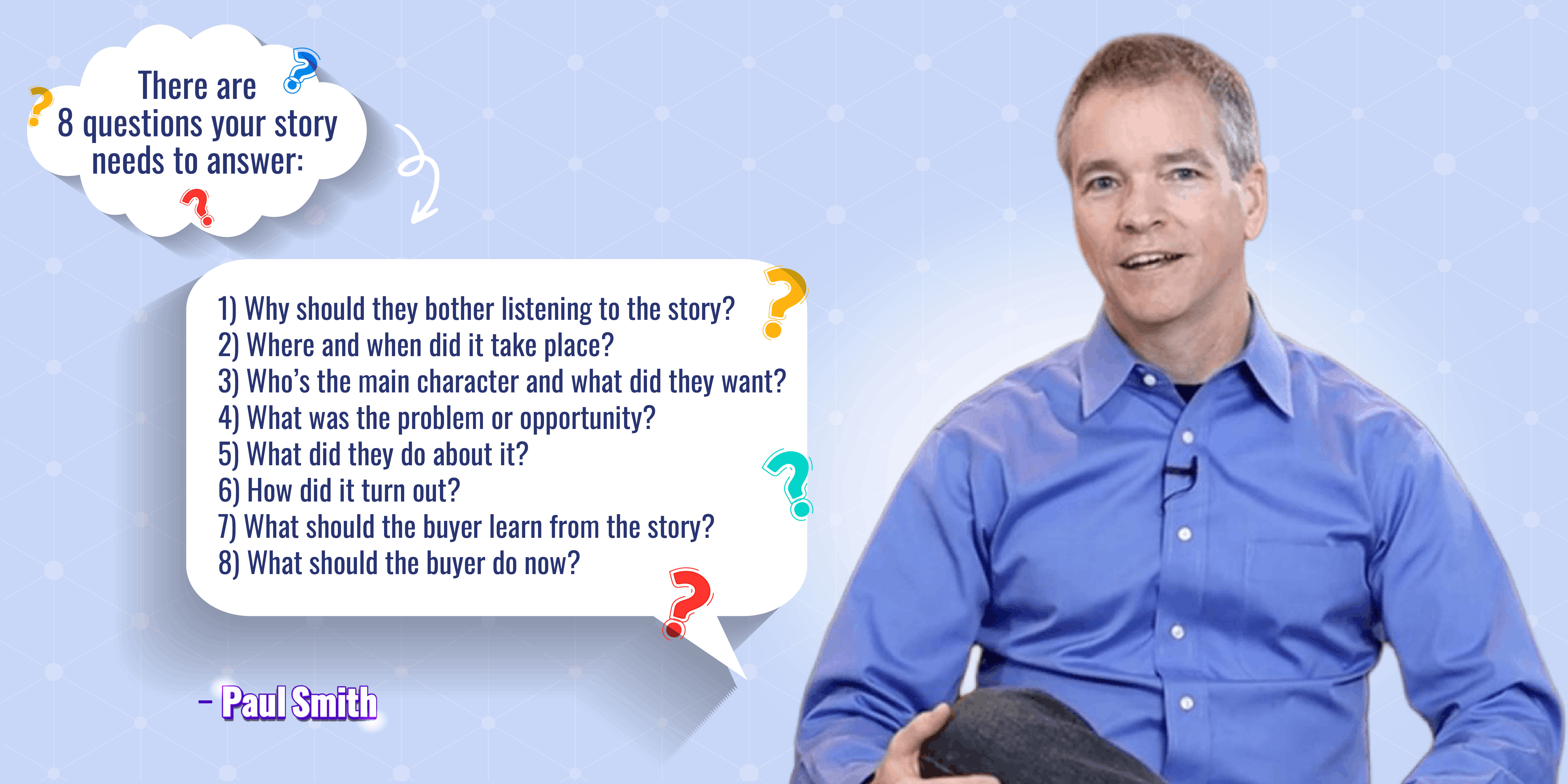
"There are eight questions I think your story needs to answer, in this particular order," Paul explains, providing a universal framework for crafting compelling narratives.
Understanding this structure transforms storytelling from an art into a repeatable skill that any salesperson can master.
Why This Works: This structure mirrors how humans naturally process and remember stories. Answering "where and when" early signals it's a true story, not fiction. Following the natural narrative arc keeps listeners engaged. Letting buyers draw their own conclusions transforms your recommendation into their idea - the most powerful form of persuasion. When the buyer says yes to their own idea, you've achieved consultative selling at its finest.
"There's a very simple technique to create a surprise ending," Paul promises. "Take one or two small but vital pieces of information that typically belong at the beginning of the story and don't give them to your audience until the end of the story. Presto, surprise ending."
Paul illustrates this with the story of James Watt, withholding the protagonist's last name and the year until the end, transforming a simple anecdote into a revelation about the inventor of the steam engine.
Why This Works: The physiological release of adrenaline during surprise literally changes brain chemistry in ways that enhance memory formation. Since sales stories only work if prospects remember them (especially when they're making decisions days or weeks later), making your stories more memorable through surprise endings directly translates to higher conversion rates. The prospect who vividly remembers your story is the prospect who chooses you.
Master a different emotional component of sales with Mark Bowden and his nonverbal sales communication & body language insights.
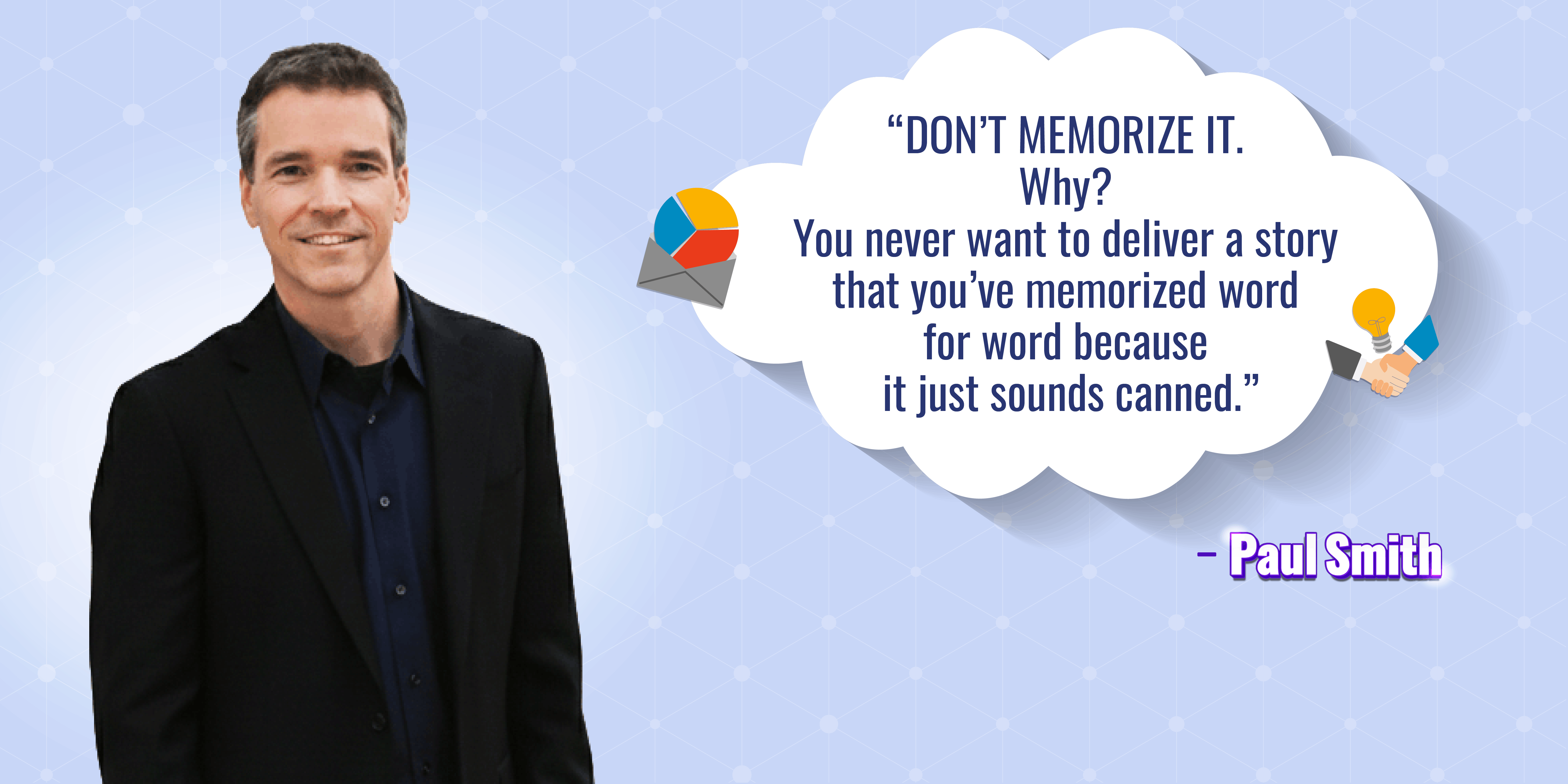
"Don't memorize it," Paul warns emphatically. "The moment the tone of the conversation changes from just conversational to something that sounds scripted and memorized, that's when I know the sales pitch is on and the hairs on the back of my neck stand up, and I immediately go into defensive mode."
Authentic delivery requires a completely different preparation approach than most salespeople use.
Why This Works: This structure mirrors how humans naturally process and remember stories. Answering "where and when" early signals it's a true story, not fiction. Following the natural narrative arc keeps listeners engaged. Letting buyers draw their own conclusions transforms your recommendation into their idea - the most powerful form of persuasion. When the buyer says yes to their own idea, you've achieved consultative selling at its finest.
"I like to kind of walk through someone, and kind of discuss, well, ‘how much are you losing every month by doing this?’" Steve shares his practical approach to creating urgency. "And it becomes almost like a future story of theirs. Like you will be losing this much money every month and maybe you can kind of walk them through and show them all the places that they're giving something up or losing something or not gaining something by not making a decision."
This technique transforms abstract future loss into tangible present reality by creating a narrative projection.
Why This Works: Steve's approach creates a personalized projection that feels more real than a generic case study because it's based on their actual numbers and situation. When you help prospects calculate their own future losses, you're not being pushy - you're being helpful by illuminating a blind spot. Combined with Paul's recommendation to follow up with a story about someone who actually experienced those consequences, you create both logical and emotional urgency that's hard to dismiss.
Paul Smith's approach to sales storytelling reveals a fundamental truth: in a world where every salesperson has access to the same features, pricing strategies, and sales techniques, your stories become your most powerful differentiator. Stories reach both the emotional decision-making brain and the rational justification brain. They're 6-22 times more memorable than facts alone. And they transform you from just another vendor into a trusted advisor with a unique perspective.
Start by making your wish list - identify which of the 25+ story types you need throughout your sales process. Then find real events from your experience, your customers' experiences, or your company's history that can serve each purpose. Structure them using the eight essential questions, add surprise endings where appropriate, and practice delivering them conversationally rather than from a script.
The salespeople who master storytelling don't just close more deals - they build stronger relationships, command higher prices, and create memorable experiences that turn buyers into advocates.
As Paul puts it: "There's only one picture upstairs in my kids' bathroom, and it's the one with the story attached to it." (You’ll have to listen to the full interview for the story behind that!)
Steve Benson started his career as a field sales rep, learning firsthand the challenges of managing territories, routes, and client relationships on the road. That experience led him to found Badger Maps, the go-to route planning app for outside sales teams, and launch the Outside Sales Talk podcast, where he brings the brightest minds in sales together to help reps in the field thrive.
Badger Maps is a routing & mapping app that automates data collection and uplevels field team performance. From planning your day to managing your territories, Badger optimizes every aspect of the field sales process.
Looking for our logo?
Grab a Zip packed with our logo in PNG and EPS formats.


